Category: Uncategorized

  • How to Pack Dishes and Glassware in Plastic Moving Bins

    Moving Guide

    How to Pack Dishes and Glassware in Plastic Moving Bins

    Your kitchen is the most fragile room in any apartment. This guide walks you through exactly how to pack dishes, glasses, mugs, and pots in reusable plastic moving bins — so nothing breaks and everything fits.

    Reserve Your Bins — Free Delivery

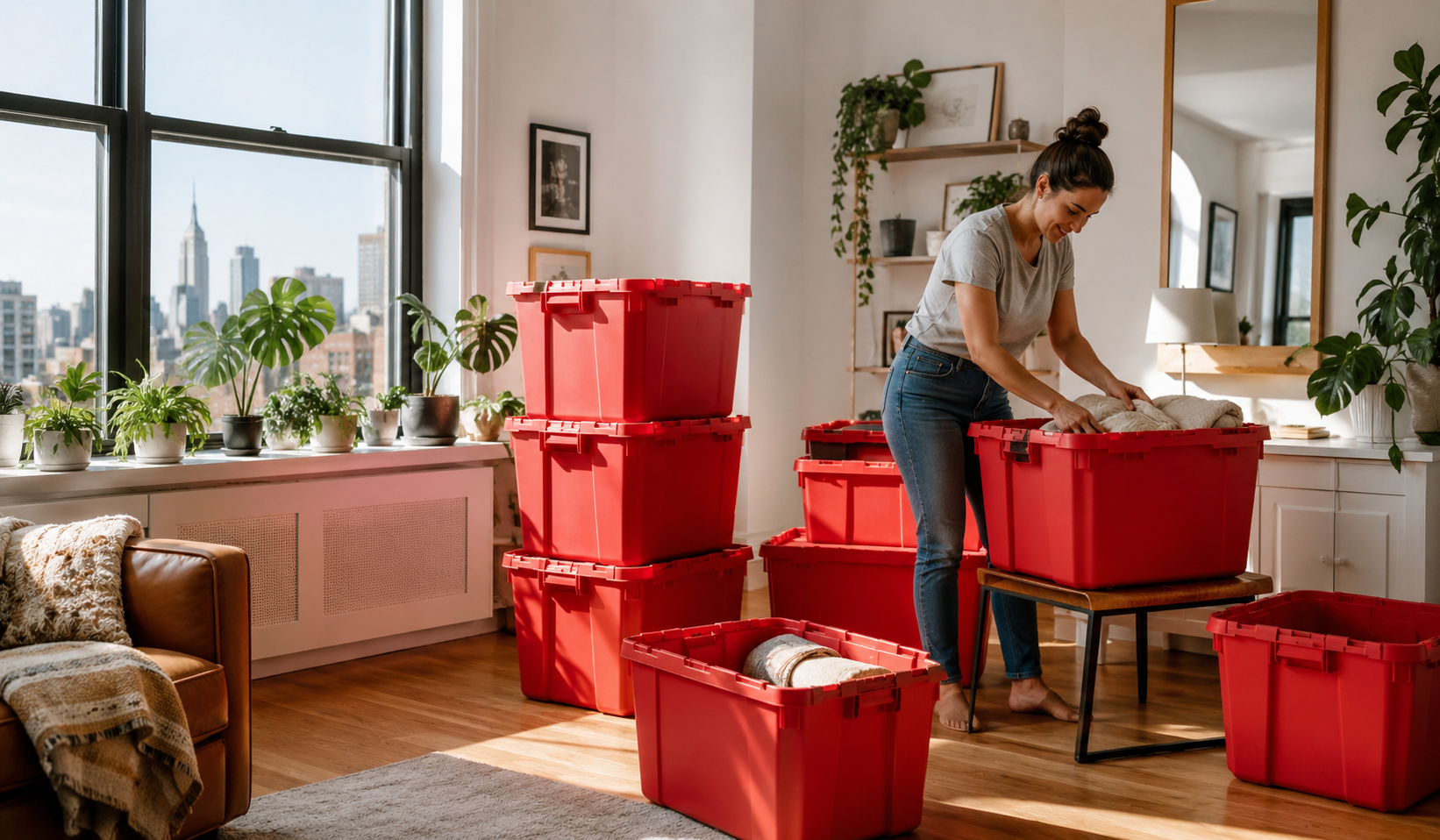
    Red reusable plastic moving bins packed with kitchen items ready for moving day

    Quick Answer

    How do you pack dishes in plastic moving bins?

    Stand plates vertically — never flat — and wrap each one in packing paper or bubble wrap before placing. Pack glasses upside-down with padding inside the bowl and between each piece. Fill every gap with crumpled paper so nothing shifts in transit. Reusable plastic bins are ideal for kitchen packing: they’re rigid, stack securely, and each bin holds up to 65 lbs — far more than a cardboard box before the bottom gives out. For heavy items like cast iron, keep each bin under 40 lbs so it’s easy to carry safely.

    Why Plastic Bins

    Why plastic moving bins are better for your kitchen

    Cardboard boxes collapse. The moment you stack them, or a corner gets wet, or someone trips — your dishes pay the price. Reusable plastic moving bins were built to handle exactly this problem.

    ✓
    Rigid walls on all six sides. Your stack of plates won’t punch through the side of a plastic bin the way it will punch through cardboard.
    ✓
    Secure lids, no tape required. Each bin snaps shut and stays closed in transit — no tape, no flaps popping open mid-move.
    ✓
    Holds up to 65 lbs. A kitchen load of plates, bowls, and mugs fits easily without worrying about the bottom dropping out.
    ✓
    Stackable under load. Bins stack flat on dollies and in the moving truck without crushing the contents beneath them.
    Stacked red plastic moving bins with secure lids, ready for kitchen packing

    Supplies

    What you’ll need before you start packing

    EazyCrate delivers the bins and dollies. Everything else you’ll want to pick up at a hardware or shipping supply store, or order online before moving day.

    Item What it’s for How much to get
    Packing paper (unprinted newsprint) Wrapping plates, bowls, and cups without leaving ink marks 1–2 reams for a full kitchen
    Bubble wrap Stemware, wine glasses, and anything with a thin stem or base One small roll per kitchen
    Packing tape Securing bubble wrap and paper around fragile items 1–2 rolls
    Permanent marker Labeling each bin: contents + room 1 marker
    Labels or masking tape Sticking notes to bin sides visible during the move 1 roll or pad

    Tip: Pack your most fragile kitchen items last, so they load last into the truck and come off first — minimizing how long they spend under other bins.

    Bin Count Guide

    How many bins does your kitchen need?

    Kitchen contents are dense — dishes, pots, pans, and pantry items add up fast. These estimates cover a typical kitchen load. If you entertain regularly or have a lot of cookware, add one or two extra bins.

    Apartment Size Estimated Kitchen Bins What fits
    Studio 2–3 bins Dishes, glasses, small appliances, pantry basics
    1 Bedroom 3–5 bins Full dish set, glassware, pots and pans, pantry
    2 Bedroom 5–7 bins As above plus bakeware, larger appliance boxes, extra storage
    3 Bedroom+ 7–10 bins Full kitchen, entertaining ware, wine glasses, full pantry

    Not sure exactly how many you need? Use our Moving Bin Calculator to get a count based on your full apartment. You can always swap for more bins after delivery if you miscounted.

    Get your bins delivered before packing day

    We deliver to your door, pick them up when you’re done, and sanitize each bin before the next rental. No cardboard. No tape. No collapse.

    Reserve Your Bins Now

    Step-by-Step

    How to pack plates and bowls

    Plates break most often because people pack them flat. Gravity and vibration during the move push all the weight onto the center — and that’s where they crack. Pack them vertically and you distribute the load across the plate’s strongest axis.

    Plates

    1. Lay a sheet of packing paper on a flat surface. Set one plate in the center at an angle.
    2. Fold the corners over the plate, then roll it toward the opposite corner to create a snug wrap.
    3. Wrap 2–3 plates together in a bundle to save paper and add cushion.
    4. Place bundles standing vertically in the bin — like records in a crate. Never flat.
    5. Fill any gaps on the sides and top with crumpled packing paper to eliminate movement.

    Bowls

    1. Wrap each bowl individually in packing paper.
    2. Nest bowls together in sets of 2–3, with a layer of paper between each.
    3. Pack nests upside-down in the bin for extra stability — the base sits on the bottom.
    4. Heavier stoneware bowls go in first, lighter ceramic on top.
    5. Pad all gaps. A bowl that slides in transit is a bowl that breaks.
    Weight tip: Plates are heavier than they look. A stack of 12 dinner plates can weigh close to 15 lbs. Don’t fill an entire bin with just plates — mix with lighter items like linens or pantry boxes to keep weight manageable.

    Wine glasses wrapped in bubble wrap being packed upside-down into a red plastic moving bin

    Glassware

    How to pack glasses and stemware

    Glasses break at the rim and the stem. Both problems have the same solution: internal padding and upside-down packing.

    Everyday drinking glasses

    1. Stuff the inside of each glass with crumpled packing paper to cushion from within.
    2. Place the glass upside-down on a sheet of packing paper. Roll and tuck the paper around it.
    3. Pack glasses upside-down in the bin, leaving the base facing up. This protects the rim — the most fragile point.
    4. Never stack glasses on top of each other without a thick layer of padding between every row.

    Wine glasses and stemware

    1. Wrap the stem first with a strip of bubble wrap secured with tape. The stem is the breaking point.
    2. Wrap the bowl separately with packing paper, then do a full wrap of the entire glass.
    3. Pack upside-down, stem up, with the widest part of the glass against the bin floor.
    4. Never pack stemware in the same layer as heavier items. Give them their own layer, fully padded.

    How to pack mugs and cups

    Mugs are sturdier than stemware but the handle is always the weak point. If the handle takes a hit against another mug or the bin wall, it breaks.

    1. Wrap each mug individually in packing paper, tucking a layer of paper into the cup of the mug.
    2. Wrap the handle separately with an extra strip of paper or bubble wrap and tape it in place.
    3. Pack mugs upside-down so the rim — not the base — bears any impact from shifting.
    4. Alternate handle directions when packing side-by-side, so handles don’t lock and pull against each other.
    5. Fill the bin layer fully before adding the next — loose items shift and collide.
    Fragile label: Clearly mark any bin with glassware or mugs on the side facing out when stacked. This helps whoever is loading and unloading handle it accordingly.

    How to pack pots, pans, and heavy cookware

    Pots and pans are the heaviest items in your kitchen, and they don’t need much wrapping — but they do need smart packing to avoid scratching each other or overloading a single bin.

    1. Pack pots and pans in their own bin, separate from dishes and glasses. The weight difference matters when stacking and carrying.
    2. Place the largest pot or pan on the bottom. Nest smaller pieces inside it to save space.
    3. Put a layer of packing paper between nested pots and pans to prevent scratching on non-stick surfaces.
    4. Pack lids separately, standing vertically in the bin like plates — or wrap and nest them inside a pot.
    5. Cast iron goes in last and gets its own bin if necessary. Cast iron alone can push a bin close to the 65 lb limit.
    Weight limit: Each EazyCrate bin holds up to 65 lbs. For a bin of pots and pans, you’ll rarely hit that limit — but a bin of cast iron can surprise you. Keep it under 40 lbs for safe carrying, regardless of what the bin can technically hold.

    Ready to skip the cardboard altogether?

    EazyCrate delivers sanitized reusable plastic moving bins to your door — with a dolly included. Pick-up scheduled when you’re done.

    Book Your Crates Today

    What to Avoid

    Common mistakes when packing dishes in plastic bins

    Plastic bins are more forgiving than cardboard, but packing mistakes still cost you dishes. These are the most common ones — and how to fix them.

    01
    Packing plates flat instead of vertically.

    Flat plates take the full vertical load from stacking and road vibration. Vertical plates distribute force across the strongest axis — the rim. Always pack on edge.

    02
    Leaving air gaps in the bin.

    A bin is only as safe as its fill level. Empty space means items can shift, tip, and hit each other. Fill every gap with crumpled paper — even a half-inch of movement breaks stemware.

    03
    Mixing heavy and fragile items in the same bin.

    A heavy pot placed on top of wrapped wine glasses during stacking will crack them. Keep pots and pans in their own bin. Fragile glassware and everyday dishes get separate layers, or separate bins.

    04
    Skipping the wrap on “sturdy” items.

    Thick ceramic mugs and stoneware bowls feel unbreakable — until they knock against each other at 30 mph on the highway. Wrap everything, even items that feel indestructible.

    05
    Forgetting to protect stems before wrapping the bowl.

    The stem is the first thing to snap on a wine glass, and it snaps inside the wrapping where you can’t see it. Wrap the stem separately with bubble wrap first, then wrap the whole glass.

    06
    Overpacking bins to save space.

    A bin at 65 lbs is at its rated limit — not the ceiling for fragile items. For kitchen bins with dishes and glass, keep weight under 40 lbs. Heavy bins are harder to carry safely, and rough handling is what breaks things.

    NYC Logistics

    How to label and load your kitchen bins

    Labeling

    • Label each bin on two sides so it’s readable regardless of how it’s stacked.
    • Write contents + destination room: “Dishes / Glasses — Kitchen.” Vague labels slow down unpacking.
    • Add “FRAGILE” in large letters on any bin containing glassware or stemware.
    • Number your bins and keep a quick list. If something goes missing in a hallway or freight elevator, you’ll know immediately.

    NYC building considerations

    • COI (Certificate of Insurance): Most NYC buildings require one from your movers before they’ll let anyone use the freight elevator or service entrance. EazyCrate can provide a COI directly to your building whenever requested — just let us know at booking.
    • Freight elevator: If your building has a freight elevator, use it. Kitchen bins are heavy and awkward in a standard elevator — and most NYC buildings won’t allow moving in the passenger elevator anyway.
    • Elevator time slots: Book your freight elevator slot as early as possible. Popular move-in/move-out dates (end of month, September 1) book up fast.
    • Hallway staging: Stack bins on your dolly in the hallway before loading the truck. It saves trips and keeps the elevator clear for other residents.
    Labeled red plastic moving bins stacked on a dolly in a New York City apartment hallway

    Frequently asked questions

    Do I need special dish boxes, or can I use regular moving bins? +
    You don’t need special dish boxes. Reusable plastic moving bins work extremely well for dishes and glassware as long as you pack correctly — plates vertical, glasses upside-down, and every gap filled with packing paper. The rigid walls and secure lids of plastic bins actually provide better protection than the typical corrugated “dish pack” box.
    How many bins should I order for a full kitchen? +
    Estimate 2–3 bins for a studio kitchen, 3–5 for a one-bedroom, and 5–10 for a two- or three-bedroom depending on how much cookware and pantry you’re packing. If you’re unsure, use our Moving Bin Calculator to get an estimate based on your full apartment.
    What’s the weight limit per EazyCrate bin? +
    Each EazyCrate bin holds up to 65 lbs. That’s roughly twice the capacity of a typical cardboard moving box. For kitchen bins, we recommend staying under 40–45 lbs so the bin is comfortable to carry — even if the bin itself can handle more, heavy bins are harder to grip and more likely to be set down roughly.
    Do EazyCrate bins come with packing paper or bubble wrap? +
    Your rental includes bins and a dolly — packing materials like bubble wrap and packing paper are not included. You’ll need to pick those up separately at a hardware store, shipping supply store, or online retailer. Unprinted packing paper is the most useful item for dishes; bubble wrap is worth having specifically for stemware and anything with a handle or stem.
    Should I wrap every single dish, or just the fragile ones? +
    Wrap everything. Even thick stoneware bowls and ceramic mugs will chip or crack if they knock against each other repeatedly during a move. Packing paper is cheap; replacing dishes is not. Individual wrapping also adds crucial cushioning between items, which stops vibration from traveling through the stack.
    Can I pack pots and pans in the same bin as dishes? +
    We recommend keeping them separate. Pots and pans are significantly heavier and have hard edges that can chip dishes or crack glasses if they shift in transit. Packing them in their own bin also makes unloading faster — you know exactly which bin goes to the kitchen.
    How do I pack wine glasses without breaking the stems? +
    Wrap the stem first with a strip of bubble wrap and tape it in place before wrapping the rest of the glass. The stem is the weakest point and breaks before the bowl does. Pack glasses upside-down with the widest part on the bin floor, and never let glasses touch each other — full padding between every piece.
    Does EazyCrate deliver and pick up the bins, or do I drop them off? +
    EazyCrate delivers directly to your door and picks up on a scheduled date when your move is complete — no drop-off required. You keep the bins for the week of your move, then we come to you. Each bin is sanitized between rentals.
    My building requires a COI. Can EazyCrate provide one? +
    Yes. EazyCrate can produce and send a Certificate of Insurance directly to your building whenever requested. Just let us know at booking that your building needs one, and we’ll coordinate it before your delivery date — so there’s no delay on moving day.
    Are plastic moving bins actually eco-friendly? +
    Yes. Each EazyCrate bin is made from durable recyclable plastic and is rented hundreds of times over its lifetime — replacing hundreds of single-use cardboard boxes. No corrugated cardboard waste, no tape, no boxes breaking down in recycling bins after one use. Renting reusable bins is consistently the lower-waste option for local moves.

    Pack your kitchen right. Start with the right bins.

    EazyCrate delivers sanitized, reusable plastic moving bins to your door — with a dolly included — so you can pack your dishes, glasses, and cookware without worrying about collapse, water damage, or flimsy cardboard. We pick everything up when you’re done.
  • How We Packed a NYC Studio Apartment With 15 Reusable Bins

    How We Packed a NYC Studio Apartment With 15 Reusable Bins

    NYC Moving Case Study

    How We Packed a NYC Studio Apartment With 15 Reusable Bins

    September 7, 2026 — A 450 sq ft East Village studio. Move day. Fifteen red EazyCrate bins stacked by the elevator. The crew arrived at 9am. By noon, everything was at the new address.

    Reserve Your Bins →

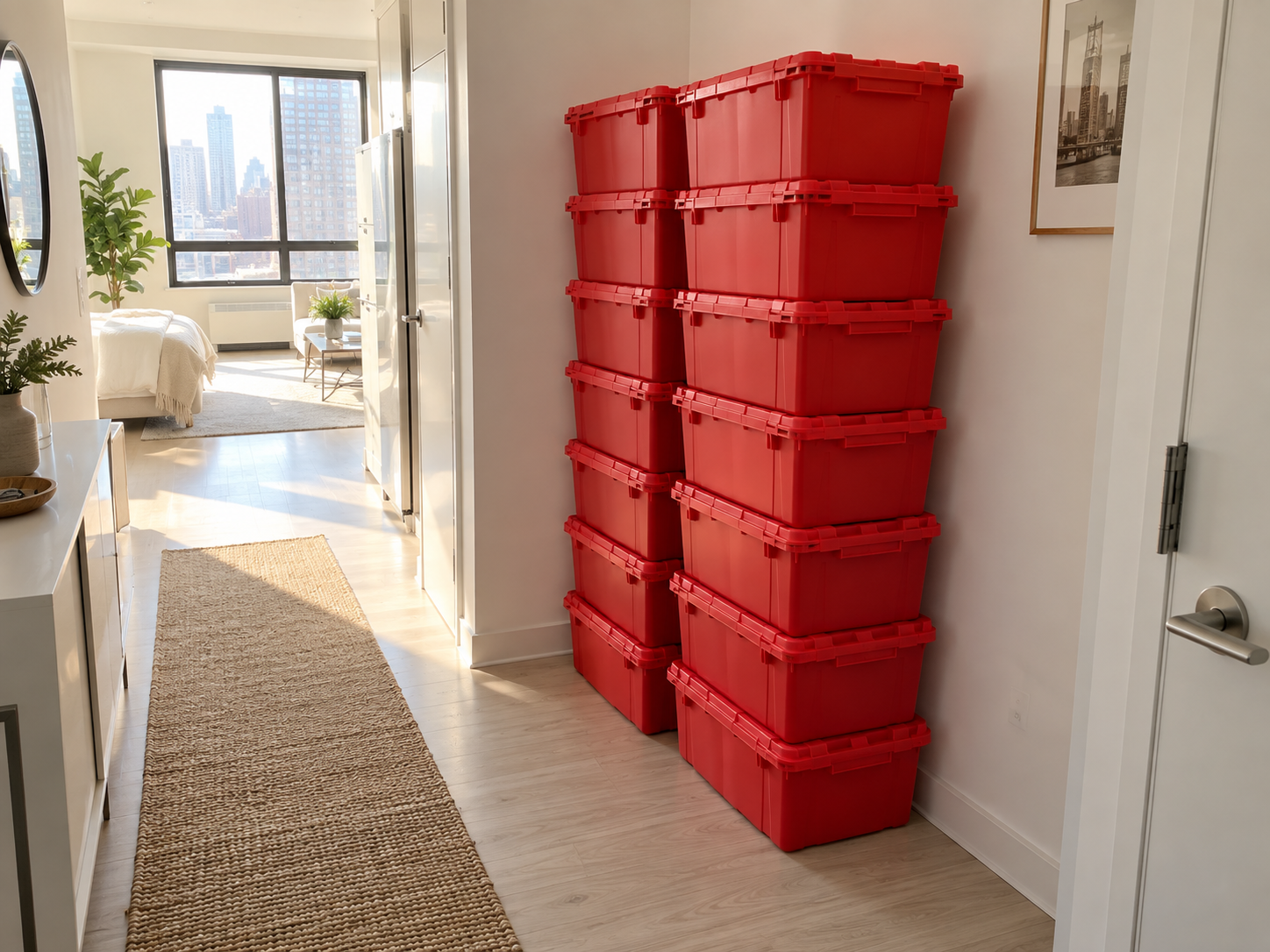
    15 red reusable moving bins stacked neatly in a NYC studio apartment hallway ready for moving day

    Quick Answer

    How many reusable moving bins do you need for a NYC studio apartment?

    For a well-organized studio (400–550 sq ft), 15 reusable bins is enough. That breaks down as: 3 bins for the bedroom, 3 for closet and clothes, 4 for the kitchen, 2 for the living room, 1 for the bathroom, and 2 for fragile and overflow items. Minimalist studios may manage with 12. Studios with large kitchens, full wardrobes, or book collections may need 18–22.

    → Not sure? Use our Moving Box Calculator for a personalized count.

    The Studio We Packed

    This move was for a single renter leaving a 450 sq ft elevator building in the East Village. Two years of belongings — but no oversized furniture. A queen bed, mid-size dresser, loveseat, TV stand, small desk, and a two-person dining table. Classic NYC studio setup.

    The building required 48 hours notice and a certificate of insurance (COI) from the mover. EazyCrate handled the COI directly — building management approved it the day before move day, elevator reserved 9am–noon.

    The 15-Bin Breakdown: Room by Room

    Here’s exactly where each bin went and what it held. Every bin was packed the night before delivery, which is why the load-out took under 45 minutes.

    Room Bins Used What Went In
    Bedroom 3 Bin 1: bedding + pillows (rolled tight) · Bin 2: folded clothes + undergarments · Bin 3: nightstand contents, personal items, small decor
    Closet 2 + 1 wardrobe box Bin 4: shoes + accessories · Bin 5: folded off-season clothes · Wardrobe box: all hanging clothes (not counted in the 15)
    Kitchen 4 Bin 6: dishes + glasses (wrapped in dish towels) · Bin 7: pots, pans + lids · Bin 8: pantry dry goods + spices · Bin 9: small appliances
    Living Room 2 Bin 10: books + magazines · Bin 11: electronics, cables, remotes + small decor
    Bathroom 1 Bin 12: toiletries, towels, cleaning supplies
    Fragile + Overflow 2 Bin 13: framed artwork + mirror (padded with clothing) · Bin 14: miscellaneous overflow
    Spare 1 Bin 15: arrived empty — used for last-minute items found on final walkthrough
    Total 15 bins + 1 wardrobe box

    If we did it again: we’d swap Bin 14 for a second wardrobe box and order 16 for a studio with a full dish set for 6+.

    Ready to book your bins?

    Reserve Your EazyCrate Bins →

    The Efficiency Difference

    Why You Need Fewer Bins Than Cardboard Boxes

    Every guide for cardboard boxes recommends 20–30 for a studio apartment. The reason you can do it with 15 reusable bins comes down to how plastic bins are built.

    • Rigid walls = no dead space. Cardboard walls compress and lose 0.5–1 inch per side. Plastic bins hold their full interior volume every time.
    • No packing tape overhead. Pre-assembled lids mean you spend time packing, not taping.
    • Uniform shape stacks perfectly. A stack of 5 EazyCrate bins on a dolly takes 10 seconds to build. Random cardboard boxes? Two minutes of Tetris.
    • Bins force organized packing. No overflow “misc” bin that fills up and never empties.
    • Clothes double as padding. Rigid sides let you wrap breakables in dish towels and clothing without risking box degradation.
    Open red EazyCrate moving bin with kitchen items neatly packed including wrapped glasses and small appliances
    EazyCrate Reusable Bins Standard Cardboard Boxes
    Studio avg needed 15 20–30
    Assembly required No — pre-assembled lids Yes — fold + tape every box
    Stacking stability High — interlocking rigid form Low — depends on fill level
    Weather resistance Yes — waterproof plastic No — collapses when wet
    Disposal after move None — we pick them up Break down + find recycling
    Packing efficiency ~20–30% higher than cardboard Baseline

    When 15 Bins Might Not Be Enough

    Fifteen bins handles the typical well-organized NYC studio. These situations push you over:

    Situation Extra Bins Needed
    Large book collection (30+ books) +2–3 bins
    Full dish set for 6–8 people +1–2 bins
    Heavy wardrobe (multiple seasons, fashion-forward) +2–3 bins
    Home office with files and equipment +2 bins
    Studio with external storage unit or basement Audit that space separately

    Not sure where you land? Our Moving Box Calculator asks about your room count and accumulation level and gives you a starting number in under a minute.

    Not sure how many you need?

    Try the Moving Box Calculator →

    Person wheeling a stack of red EazyCrate moving bins on a hand truck dolly through an NYC apartment building hallway near elevator
    Move Day Reality

    The NYC Studio Move: What Actually Happened

    NYC elevator moves have specific logistics no national moving guide addresses. Here’s the real timeline:

    • 48 hours prior: Elevator reserved 9am–noon; building required written request
    • Day before: EazyCrate provided COI to building management; approved same day
    • Evening before: Bins delivered to current address; resident packed overnight at their own pace
    • Move morning: Crew loaded 15 bins in 45 minutes — 5 bins per dolly trip, 3 trips
    • Transit: 22 minutes to new address
    • Unload: 30 minutes at new building
    • Total hands-on move time: Under 3 hours including transit

    “The bins make elevator moves faster. Every EazyCrate bin is the same shape — stacking on the dolly takes 10 seconds instead of 2 minutes of Tetris with cardboard.”

    How to Order Your Studio Moving Bins

    1

    Choose Your Count

    Start with 15 for a typical 400–550 sq ft studio. Add 2–3 if you have a large kitchen or wardrobe. Use the calculator if unsure.

    2

    Pick Your Delivery Date

    Book online at /book/. Same-day delivery available with 24 hours notice. We coordinate elevator reservations and COI with your building.

    3

    Pack, Move, Done

    We deliver to your current address. You pack at your pace. We pick up from your new address — no cardboard to break down or haul to recycling.

    See current pricing by bin count →

    Ready for a move-day that ends on time?

    Book Your EazyCrate Delivery →

    Serving all five NYC boroughs · Same-day delivery available · COI handled for you

    Frequently Asked Questions

    How many reusable moving bins do I need for a studio apartment?+
    For a typical NYC studio (400–550 sq ft), 15 bins handles a well-organized move. Minimalists may need 12; studios with large kitchens or extensive wardrobes may need up to 22. Use our Moving Box Calculator for a personalized count.
    Is 15 bins really enough — or are you underselling it?+
    It’s enough for a typical studio, but it requires organized packing. Our bins are larger and more rigid than cardboard boxes, so they pack 20–30% more efficiently. If you have more than 30 books, a full dish set for 8, or a fashion-heavy wardrobe, order 18–20 to be safe.
    How do EazyCrate bins compare to cardboard moving boxes?+
    EazyCrate bins are rigid plastic — they don’t collapse under weight, they’re waterproof, and they require no tape or assembly. They’re uniform in shape, which makes stacking and dolly loading significantly faster. Most customers need 30–40% fewer bins than cardboard boxes for the same volume of belongings.
    Can I add more bins after my initial order?+
    Yes — contact us and we can arrange a supplemental delivery, subject to availability and timing. To avoid this, use our calculator or round up by 2–3 bins when ordering.
    Do the bins come with labels?+
    Yes. Every EazyCrate delivery includes labels for each bin — room name and contents. We also include zip ties to secure the lids.
    What’s the largest item that fits in a moving bin?+
    Our standard bin dimensions handle most kitchen appliances, folded clothing, books, and pantry items comfortably. Mattresses, TVs, and hanging clothes need a wardrobe box — available as an add-on.
    Do I need wardrobe boxes too?+
    For a studio with a standard-size closet, 1 wardrobe box handles most hanging clothes. We recommend adding one wardrobe box to any studio order — it’s not included in the 15-bin count above.
    How long do I keep the bins?+
    Standard rental is one week. Extension rates apply if you need more time — see our Pricing page. Just let us know when you’re ready for pickup.
    Is there a delivery fee?+
    Delivery and pickup are included in your rental — no hidden fees. See our Pricing page for current rates by bin count.
    What neighborhoods do you deliver to?+
    We serve all five NYC boroughs. See our Locations page for service area details or call (347) 352-5566 to confirm coverage for your specific addresses.

  • How to Reserve a Freight Elevator for Moving in NYC (And Move Faster)

    Moving Guide

    How to Reserve a Freight Elevator for Moving in NYC (And Move Faster)

    Reserve 2 weeks out. Submit your COI early. Use plastic bins to cut your elevator trips — and actually finish on time.

    Reserve Your Crates →

    Red EazyCrate bins stacked on dolly at NYC apartment building service entrance, ready for freight elevator move

    Quick Answer

    To reserve a freight elevator in NYC: contact building management at least 2 weeks before your move date — or 3–4 weeks during peak season (May–September). You’ll need a Certificate of Insurance (COI) from your movers or crate rental company showing $1M+ general liability, with the building listed as additional insured. Confirm your elevator window in writing, use the service entrance on move day, and return the elevator clean within your time slot.

    Why NYC Buildings Require Freight Elevator Reservations

    There’s no city law mandating freight elevator reservations — each building sets its own rules. But most co-ops, condos, and larger rental buildings in NYC require them for a simple reason: the freight elevator is a shared resource. Without a reservation system, move-ins and move-outs collide, lobbies get blocked, and neighbors complain.

    Building management coordinates move schedules to limit elevator downtime to one move at a time, protect lobby finishes, and ensure there’s always a super or porter available to operate the elevator when required. Some older NYC buildings don’t have freight elevators at all — in those cases, you’ll typically use the passenger elevator during an off-peak window, with the same reservation and COI requirements.

    The bottom line: plan your elevator reservation before you book anything else. The elevator slot is the constraint your entire move schedule has to work around.

    What NYC Buildings Typically Require for Freight Elevator Moves

    Requirements vary by building and management company, but these are the most common items across NYC co-ops, condos, and rental buildings:

    Requirement What It Is Typical Value
    Advance reservation How far ahead you must book the elevator 2–4 weeks (3–4 weeks May–Sep)
    Certificate of Insurance (COI) Proof movers or crate company carry liability + workers’ comp; building listed as additional insured $1M+ general liability
    Security deposit Refundable hold against elevator or lobby damage $250–$1,000 (co-ops + luxury buildings)
    Elevator reservation fee Optional fee some buildings charge for the window $0–$400; most buildings charge nothing
    Move hours Time window when moves are permitted Mon–Fri 9 AM–5 PM; weekends often restricted or banned
    Service entrance Required entry point for deliveries and moves Always required — never use the main lobby
    Padding and floor protection Required covering to protect the elevator cab Walls + floor; usually supplied by movers

    How to Reserve a Freight Elevator: 7 Steps

    1

    Check your lease and building rules

    Your lease or building handbook will have the move policy — advance notice required, permitted hours, service entrance location, and whether the building requires an elevator operator. Know the rules before you call.

    2

    Call or email building management

    Contact the super, property manager, or management company directly. Ask about available dates, elevator window length (typically 4–8 hours), permitted move hours, and what paperwork to submit.

    3

    Choose your move date and elevator window

    Pick a weekday if possible — weekends are restricted or banned in most NYC buildings. During peak season (May–September), good slots go fast. Lock in your date before booking movers.

    4

    Submit your COI and required paperwork

    Most buildings require a COI showing $1M+ general liability coverage with the building listed as additional insured. EazyCrate provides a COI at no charge, typically within 24–48 hours of your request.

    5

    Confirm the reservation in writing

    Ask for email confirmation. Get the building contact name, your exact elevator window, the service entrance address, and any deposit or fee instructions. Written confirmation protects you if there’s a dispute on move day.

    6

    Arrange elevator padding and floor protection

    Buildings require the elevator cab to be padded before loading starts. Most professional moving teams bring their own blankets and floor mats. Confirm this with your movers in advance.

    7

    Finish on time and return the elevator clean

    Buildings are strict about move windows. Running over blocks another resident’s reservation and risks your security deposit. Build in a 30-minute buffer. Remove all padding and clear any debris.

    NYC apartment building superintendent reviewing freight elevator reservation form at building management desk

    Freight Elevator Reservation Timeline

    Use this schedule to stay ahead of the building’s paperwork requirements and keep your move on track:

    When What to Do
    4+ weeks out (May–Sep) Call building management; request freight elevator date and window; confirm available weekdays
    3 weeks out Submit COI from movers or crate rental company; pay any reservation deposit if required
    2 weeks out Get written confirmation; record building contact name, service entrance address, and exact window times
    1 week out Verify elevator reservation is still on; confirm move-day logistics with building
    2 days out Remind building staff of your move; confirm elevator padding arrangement with movers
    Move day Arrive at service entrance on time; return elevator clean within your window

    EazyCrate provides COI at no charge — within 24–48 hours.

    Plastic bins delivered to your door. COI included. Built for NYC elevator moves.

    Reserve Your Crates →

    How Your Packing Choice Affects Elevator Time

    Here’s something no moving company will tell you: the type of container you pack in directly affects how many elevator trips you need — and whether you finish inside your reserved window.

    The cardboard problem

    Cardboard boxes come in every size. They don’t stack flush. The gaps between mixed-size boxes waste elevator floor space. A standard NYC freight elevator cab should hold 2–3 dolly loads per trip. With mixed cardboard sizes, you lose 15–30% of that capacity to gaps and unstable stacking.

    The plastic bin advantage

    Plastic moving bins are identical in size and stack perfectly. A dolly loaded with EazyCrate bins uses elevator space efficiently — wall to wall, floor to safe height. Fewer trips means your window stays intact and you return the elevator on time.

    Cardboard Boxes EazyCrate Plastic Bins
    Size consistency Varies — mixed heights and widths Uniform — identical dimensions every time
    Stack density in elevator Lower — gaps from irregular sizes Higher — flush stacking, no wasted space
    Collapse risk during loading Yes — cardboard weakens under load No — rigid plastic walls hold their shape
    COI included No (mover’s policy required separately) Yes — EazyCrate provides at no charge
    Setup time Assembly required on moving day Pre-loaded and ready to move
    Red EazyCrate plastic moving bins stacked inside NYC freight elevator — efficient apartment move

    7 Freight Elevator Mistakes NYC Movers Make (And How to Avoid Them)

    These mistakes cost people their deposit, their elevator slot, or their moving day. Here’s what to watch for:

    Mistake 1

    Booking the elevator too late

    During peak season, weekday slots are gone weeks in advance. Call before you book movers — the elevator availability determines your move date, not the other way around.

    Mistake 2

    Not reading the building rules first

    Every building has different policies. Some require a union elevator operator. Some ban weekend moves entirely. Check your lease before you plan anything.

    Mistake 3

    Forgetting the COI until move week

    Buildings won’t let you use the elevator without a COI. Getting one takes time. Request it from your movers or crate company the day you confirm your date.

    Mistake 4

    Assuming the weekend is an option

    Most NYC buildings ban or heavily restrict weekend moves. Never assume — always confirm before scheduling a Saturday or Sunday move.

    Mistake 5

    No written confirmation

    A verbal yes from the super is not a reservation. Get it in writing — email is fine. If there’s a dispute on move day, written confirmation is your only protection.

    Mistake 6

    Underestimating padding requirements

    Buildings enforce padding rules and will stop your move if the elevator isn’t protected before loading starts. Confirm your movers are bringing elevator blankets and floor protection.

    Mistake 7

    Using cardboard boxes instead of uniform bins

    Mixed cardboard sizes mean wasted elevator space per trip. More trips means more time. More time means risk of losing your window. Uniform plastic bins stack tightly and get more done in fewer trips.

    Ready to Move Smarter?

    Plastic bins + COI included. Delivered to your door, picked up after your move. Built for NYC building requirements.

    Book Your Crates →

    Frequently Asked Questions

    How far in advance should I reserve a freight elevator in NYC? +
    Reserve at least 2 weeks before your move date. During peak season (May through September), aim for 3–4 weeks. Popular weekday slots fill up fast. Lock in your elevator window before you book movers or order crates.
    What is a COI and why does my building need it? +
    A COI (Certificate of Insurance) shows that your movers or crate rental company carry general liability insurance ($1M+ is standard) and workers’ compensation coverage. Most NYC buildings require the building to be listed as additional insured. It protects the building if anyone is injured or property is damaged during the move.
    How much does it cost to reserve a freight elevator in NYC? +
    Most buildings charge nothing for the reservation itself. Some charge $0–$400 for the elevator window. Co-ops and luxury buildings may require a refundable security deposit of $250–$1,000 against potential damage. You get the deposit back if the elevator is returned in good condition.
    What are typical freight elevator hours in NYC apartments? +
    Most buildings allow moves Monday through Friday, 9 AM to 5 PM. Some allow moves until 6 PM. Weekend moves are restricted or banned in the majority of NYC residential buildings, especially co-ops. Always confirm the permitted hours with your building before scheduling.
    Can I use the passenger elevator if there’s no freight elevator? +
    Yes — many older NYC buildings don’t have a freight elevator. The building will typically designate a passenger elevator for move use during off-peak hours. The same COI and reservation rules usually apply. Confirm the arrangement with your super in advance.
    What happens if my move runs over the time window? +
    Buildings enforce time windows strictly. Going over can result in losing your security deposit and being charged for blocking another resident’s reservation. If you think you’ll need more time, request a longer window upfront. Don’t assume extensions will be available on move day.
    Does EazyCrate provide a COI for moves? +
    Yes. EazyCrate provides a Certificate of Insurance at no charge. Once you book and confirm your move date, request the COI and we’ll have it ready within 24–48 hours. Submit it to your building management as soon as you have it.
    How do plastic bins help during a freight elevator move? +
    Plastic bins are uniform in size, which means they stack flush and fill elevator space efficiently. Unlike cardboard boxes, which come in a variety of sizes and leave gaps when stacked, plastic bins load tightly onto a dolly. Fewer trips per load means you’re more likely to finish inside your reserved window.
    Do all NYC apartment buildings have freight elevators? +
    No. Many older NYC buildings — particularly pre-war walkups and smaller rentals — have no freight elevator. Buildings built after roughly the 1960s and larger high-rises are more likely to have one. Check your building’s layout when you first view the apartment so you can plan accordingly.
    What’s the difference between a freight elevator and a service elevator? +
    In NYC residential buildings, the terms are often used interchangeably. A freight elevator is a heavier-duty lift designed to carry large loads. A service elevator is typically the same thing. In practice, it’s the back elevator you’ll use instead of the main passenger elevator. Either way, the reservation, COI, and padding requirements apply.

    Move With Confidence. COI Included.

    EazyCrate delivers plastic moving bins to your door, provides COI within 24–48 hours, and picks up after your move. Built for NYC apartments and freight elevator requirements.

    Book Your Crates →

  • NYC Office Moving Checklist: Crates, COI, Freight Elevators, and Department Planning

    Office Moving Guide

    NYC Office Moving Checklist: Crates, COI, Freight Elevators, and Department Planning

    Everything your NYC office move needs — in the right order. Freight elevator booking, COI documentation, crate counts by department, and move day logistics.

    Reserve Your Crates

    Office manager reviewing plans with an EazyCrate representative in a modern NYC high-rise hallway, rows of bright red reusable plastic moving crates staged on steel dollies in the background
    Quick Answer

    What does an NYC office moving checklist cover?

    A complete NYC office move checklist covers: (1) notifying both buildings and booking freight elevator windows 4–6 weeks out, (2) requesting Certificates of Insurance from all vendors, (3) calculating crate counts by department, (4) labeling and packing crates by team, and (5) coordinating delivery and pickup logistics on move day. EazyCrate handles crate delivery, COI documentation, and pickup — free delivery included.

    Why NYC Office Moves Require a Detailed Checklist

    Moving an NYC office is not like moving an apartment. You’re coordinating building management at two addresses, booking freight elevator time windows, requesting Certificates of Insurance from every vendor, organizing packs by department, and keeping your team productive throughout a move that can span multiple days. Miss one step and you hit delays — a rejected COI, a missed elevator window, or crates that don’t match your headcount.

    This checklist covers everything in the right order, from the moment you confirm your move date through the day you’re fully set up in your new space. We’ve organized it by time horizon so nothing slips.

    Phase 1

    8 Weeks Out: Planning and Building Coordination

    Start here. Lock in logistics early — popular move dates and freight elevator windows fill up weeks in advance.

    Task Who Notes
    Confirm move date with both buildings Office manager Get written confirmation from both landlords
    Notify building management at current address Office manager Ask about move-out rules, elevator, dock access
    Contact building management at new address Office manager Request move-in rules, elevator reservation form
    Book freight elevator windows at both buildings Office manager Book ASAP — premium move dates fill weeks out
    Identify dock access hours and restrictions Office manager Note truck size limits, delivery window hours
    Confirm move vendors (movers + crate rental) Operations Request COI documentation early
    NYC freight elevator tip: Most NYC commercial buildings require elevator reservations 2–4 weeks in advance. Some charge hourly fees. Book as early as possible and get the reservation in writing. EazyCrate empty-crate drop-off and pickup typically does not require a reserved elevator window — confirm with your building.
    Phase 2

    4 Weeks Out: COI and Logistics Coordination

    Task Who Notes
    Request COI from your moving company Operations Must meet the building’s requirements — get the spec from building management
    Request COI from your crate rental vendor Operations EazyCrate provides COI documentation that meets standard NYC building requirements
    Submit COIs to both buildings for review Office manager Allow 5–10 business days for approval
    Confirm new office floorplan Operations Map out department zones, server room, storage areas
    Create department packing assignments Team leads Assign one coordinator per department
    Order packing supplies (tape, labels, markers) Office manager EazyCrate crates do not come with labels — provide your own
    Phase 3

    2–3 Weeks Out: Order Your Crates

    Order crates based on your total headcount. Use the sizing guide below, then add a 10–15% buffer for common areas, IT equipment, and kitchen supplies.

    How Many Crates Do I Need for an Office Move?

    Employees Recommended Crates
    Up to 10 15 crates
    15–20 25 crates
    25–35 35 crates
    40–50 50 crates

    Each EazyCrate bin holds up to 65 lbs and snaps shut securely — no tape needed. Add extra crates for IT peripherals, kitchen supplies, or filing cabinets.

    Reserve Your Crates — Free Delivery Included

    Phase 4

    1 Week Out: Department Packing and Labeling

    Assign crates to each department and have team leads coordinate packing. A clear labeling system prevents mix-ups and speeds up unpacking at the new space significantly.

    Department Packing Guide

    Department Pack First Special Notes
    Finance / Accounting Files, binders, small equipment Label confidential file crates clearly
    IT Non-critical peripherals, cables, manuals Servers and desktops require professional movers — not crates
    HR / Legal Personnel files, office supplies Secure confidential materials before crating
    Marketing / Creative Books, decor, desk items Use padding inside crates for fragile items
    Kitchen / Common Areas Appliances, dishes, pantry items Pack heavy items in bottom of crate

    Label each crate: Department name + destination zone (e.g., “Finance — Zone B”). EazyCrate provides the crates — you provide the labels.

    Open red EazyCrate reusable plastic moving bin packed with office files, a laptop, and a desk plant — labeled and ready for an NYC office move
    Phase 5

    Move Day: Freight Elevator and Flow

    Move day success depends on who controls the elevator and how crates move through the building. Designate a point person at each location.

    Task Timing Notes
    Confirm freight elevator reservation with building Day before Get the super’s contact number
    Brief your designated move coordinators Morning of move One per floor minimum; one at the new building
    Protect floors and door frames with moving pads Before crates move Required by most NYC commercial buildings
    Load crates in reverse unpack order During move Last department to unpack goes in first
    EazyCrate arrives within your booked window Per your schedule Coordinate delivery window when booking
    Final walkthrough at old space End of move day Check closets, server room, storage, roof access
    Freight elevator coordination: EazyCrate arrives within your reserved freight elevator window. You reserve the window with building management — we work within it. Empty crate pickup typically does not require a dedicated elevator reservation.
    EazyCrate delivery team member loading department-labeled red plastic moving crates marked IT and Finance into a NYC commercial freight elevator during an office relocation
    Phase 6

    After the Move: Unpack and Return

    Most teams unpack within 1–3 days. EazyCrate picks up empty crates on a schedule that works around your team.

    Task Timeline
    Unpack by department in zone order Day 1–2
    Set up IT and server infrastructure Day 1
    Confirm internet and phone lines active Day 1
    Schedule EazyCrate empty crate pickup Day 2–3
    Update business address with vendors, banks, USPS Week 1
    Update Google Business Profile address Week 1
    Send new address announcement to clients Week 1

    Need Crates for Your NYC Office Move?

    EazyCrate delivers clean red reusable crates to your building, with COI documentation and free delivery. Book in minutes.

    Reserve Your Crates

    Common NYC Office Move Mistakes to Avoid

    Mistake Why It Causes Problems How to Avoid It
    Booking freight elevator too late Popular move dates fill 3–4 weeks out Book immediately after confirming your move date
    Submitting COI too close to move day Buildings need 5–10 days to review; rejection delays everything Request COI 4 weeks out, submit immediately
    No COI from crate vendor Building may refuse entry to crate delivery team EazyCrate provides COI meeting NYC building requirements — confirm when booking
    Skipping department labeling Crates get mixed in transit; unpacking takes 2–3× longer Label every crate with department name and destination zone
    Underestimating crate count Last-minute rush orders or overflow into cardboard Use the sizing guide above and add 10–15% buffer for common areas
    Packing IT servers in crates Servers require professional equipment movers with proper insurance Coordinate IT equipment separately from crate rental logistics

    Frequently Asked Questions

    How many crates do I need for a 20-person office move? +
    A 15–20 person office typically needs 25 crates. Add 3–5 more for kitchen supplies, common area items, and file storage. When in doubt, order a few extra — it’s easier to have buffer than to run short mid-pack.
    Does EazyCrate provide a Certificate of Insurance for NYC office moves? +
    Yes. EazyCrate provides COI documentation that meets standard NYC commercial building requirements. Request your COI when booking and allow a few days for processing so you can submit it to both buildings well before move day.
    Do I need to reserve a freight elevator for crate delivery? +
    You need to reserve a freight elevator window for the main move when your team is actively loading crates. EazyCrate arrives within your booked window. Empty crate drop-off and pickup for empty bins typically does not require a reserved elevator window — confirm with your building management.
    Does EazyCrate provide labels for crates? +
    No. EazyCrate provides clean, ready-to-use crates — labeling is your team’s responsibility. Use adhesive labels or a label maker to mark each crate with the department name and destination zone. Clear labeling is one of the highest-impact things you can do to speed up unpacking.
    How far in advance should I book office moving crates? +
    Book 2–3 weeks in advance for most office moves. If your move date falls on a Monday, end of month, or near a holiday, book earlier — crate availability tightens around those dates. Booking early also gives you time to get COI documentation submitted to your building.
    Can EazyCrate handle a multi-day office move? +
    Yes. EazyCrate rental is priced weekly, so you keep the crates for the full duration of your move — whether that’s one day or several. Crate pickup is scheduled when your team is done unpacking, not on a fixed return date.
    How much does office moving crate rental cost? +
    EazyCrate pricing is based on the number of crates and rental duration. Delivery and pickup are included in the rate. See our pricing page for current rates, or book online to get a quote for your specific crate count.
    What’s the difference between renting crates vs. using cardboard for an office move? +
    Reusable crates snap shut without tape, stack uniformly on dollies, and hold up to 65 lbs without collapsing. Cardboard boxes vary in size, require tape, and can fail under heavier loads. For a commercial move through tight freight elevator spaces, crates are significantly more efficient.
    Do you deliver to offices in New Jersey (Jersey City, Hoboken)? +
    Yes. EazyCrate delivers to Jersey City and the surrounding New Jersey area with no cross-river surcharge. Delivery and pickup are included in the standard rate.
    Is EazyCrate available for same-week office moves? +
    We do our best to accommodate short-notice bookings. Same-week availability depends on your crate count and delivery location. Book online or call us at (347) 352-5566 to check availability for your specific move date.

    Ready to Book Your Office Move Crates?

    Free delivery. COI included. Clean red crates delivered to your NYC building.

    Book Now

  • Best Knots for Moving: Secure Your Load the Right Way

    Best Knots for Moving: Secure Your Load the Right Way

    Moving Guide

    Best Knots for Moving: How to Secure Your Load in a Moving Truck

    If you’re renting a truck and loading it yourself, one of the most overlooked skills is securing the load. Furniture shifts during a move — especially on city streets — and unsecured items damage each other, topple over, and arrive broken.

    You don’t need to be a sailor. You need four knots and how to use them.

    Should you rent moving bins instead? Read this first →

    Person demonstrating the trucker's hitch knot with thick orange rope attached to a D-ring anchor inside a moving truck

    Quick Answer: The 4 Best Knots for Moving

    The four most useful knots for moving are: the Trucker’s Hitch (maximum tension with 3:1 mechanical advantage), the Bowline (fixed loop around furniture legs or anchor rails), the Square Knot (bundling items together), and the Cleat Hitch (securing to truck anchor rails). The Trucker’s Hitch is the most important — learn this one first.

    Why Load Securing Matters

    A standard moving truck accelerates and decelerates constantly. In NYC traffic, that’s dozens of times per trip. A 200-lb dresser that’s only loosely blocked with other furniture will shift every time the truck stops. After 20 stops, it may have moved 3 feet and taken out a lamp, a box of dishes, and the side of a bookcase.

    Ratchet straps are ideal. But knowing how to tie a solid knot with moving rope is the backup skill every DIY mover needs.

    What Rope to Use for Moving

    Not all rope is appropriate for securing furniture. Here’s what to use:

    Rope Type Best For Notes
    Polypropylene rope General-purpose tie-downs Won’t stretch, UV resistant, affordable
    Nylon rope High-tension applications Slight stretch acts as shock absorber
    Manila rope Bundling light items Natural fiber, not ideal for heavy loads
    Bungee cords NOT for heavy items Unsafe under heavy load — never use

    For most moves: 3–6mm polypropylene rope or moving-specific ratchet straps. Get at least 50 feet.

    The 4 Best Knots for Moving

    1

    The Trucker’s Hitch Most Important

    Best for: Creating maximum tension in a rope run across stacked furniture

    The Trucker’s Hitch lets you pull a rope tight with 3:1 mechanical advantage — the equivalent of pulling three times as hard as you actually are. It’s the standard for cargo securing.

    1Run your rope from one anchor point across your load
    2Tie a slipped overhand loop somewhere in the middle of the running end
    3Pass the rope’s end through the opposite anchor point and back up through the loop
    4Pull the rope downward — the loop acts as a pulley and multiplies your force
    5Lock tension by tying two half-hitches around the main rope below the loop
    ✓ Rope as tight as a ratchet strap — releases in seconds
    2

    The Bowline

    Best for: Creating a fixed loop around a furniture leg or anchor rail

    The bowline creates a loop that won’t tighten or loosen under load. You can tie it around a table leg, a bed frame rail, or a truck anchor ring and rely on it to hold.

    1Create a small loop in the rope (the “rabbit hole”)
    2Pass the working end up through the loop (“the rabbit comes out of the hole”)
    3Wrap the working end around the standing part (“goes around the tree”)
    4Pass it back down through the small loop (“back into the hole”)
    5Pull both ends to tighten
    💡 Memory trick: “The rabbit comes out of the hole, runs around the tree, and goes back in.”
    3

    The Square Knot

    Best for: Bundling items together — rolled rugs, mattresses, stacked boxes

    The square knot joins two rope ends together. It’s symmetrical and flat, which makes it useful when you don’t want a bulky knot. Use only for bundling — not for high-tension applications.

    1Cross the left end over the right end and under
    2Then cross the right end over the left end and under
    3Pull both ends tight
    ⚠ Memory trick: right over left, then left over right. The granny knot (right over left twice) looks similar but slips under load.
    4

    The Cleat Hitch

    Best for: Securing rope to the anchor cleats built into most moving trucks

    Most rental moving trucks have anchor rails with metal cleats along the walls. The cleat hitch is how you lock rope to these cleats quickly and reliably.

    1Pass the rope around the bottom of the cleat
    2Cross over the top in a figure-8 pattern — one side then the other
    3Finish with a locking loop (flip a bight of rope over the end of the cleat)
    4Pull snug
    ✓ Releases with a single upward tug on the locking loop

    Fewer Knots. Easier Move.

    EazyCrate’s stackable plastic bins create a uniform, stable load — reducing how much rope and strapping you need in the first place.

    Reserve Your Moving Bins →

    How to Load and Secure a Moving Truck

    1

    Heavy items first, against the cab

    Appliances, dressers, file cabinets. Keep the center of gravity low.

    2

    Larger furniture next

    Sofas, bed frames, bookshelves standing upright against walls.

    3

    Boxes and bins on top

    Uniform-sized bins (like EazyCrate’s) stack perfectly and don’t shift like assorted cardboard boxes.

    4

    Run straps or rope every 4–6 feet

    Use Trucker’s Hitches or ratchet straps across the load, anchored to the truck’s side rails.

    5

    Fill all vertical gaps

    Standing furniture should be secured to walls. Nothing should have 6+ inches of clearance in any direction.

    Ratchet Straps vs. Rope

    Ratchet Straps Rope + Knots
    Faster to apply Requires knot knowledge
    Consistent tension every time Tension depends on technique
    Available to rent from truck company Always available if you know how
    Bulkier to store Lightweight and versatile
    Best for frequent movers Best for one-off DIY moves
    Verdict: Rent ratchet straps if available from your truck rental company. Learn the Trucker’s Hitch as your backup. Both together is best.
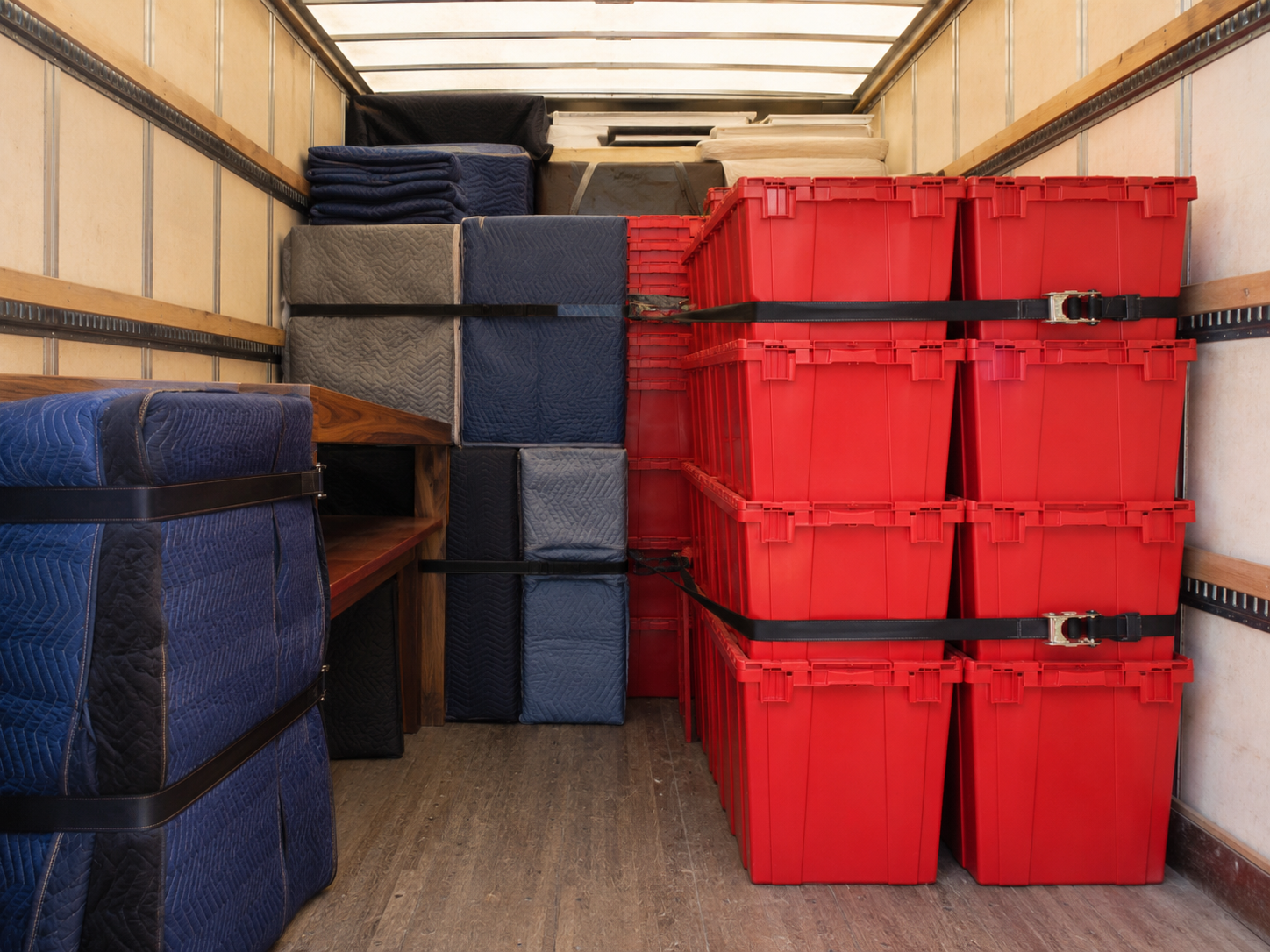
    Inside a moving truck showing stacked orange EazyCrate plastic bins secured with black ratchet straps alongside furniture wrapped in moving blankets

    Common Load-Securing Mistakes

    ⚠

    Using bungee cords for heavy furniture

    They stretch and snap under load, or simply fail. Never use bungees for items over 30–40 lbs.

    ⚠

    Not anchoring to truck rails

    Furniture roped only to other furniture will all shift together. Always anchor to the wall cleats or rail.

    ⚠

    Leaving large vertical gaps on the sides

    Tall items tip toward the walls if there’s clearance. Fill gaps with folded blankets or smaller boxes.

    ⚠

    Skipping straps for “short moves”

    Most truck damage happens in the first 5 minutes of driving. Distance is not a reason to skip securing.

    ⚠

    Loose boxes at the bottom

    Crushed boxes create gaps, which cause shifting above them. Use rigid plastic bins at the bottom layer.

    How Plastic Bins Help with Load Security

    One advantage of renting plastic moving bins over cardboard boxes is structural consistency. Because bins are uniform in size, height, and rigidity, they:

    ✓Stack reliably without shifting or collapsing
    ✓Create a stable base for furniture stacked on top
    ✓Allow rope runs across consistent heights — no gaps from varying box sizes
    ✓Don’t deform under load the way cardboard does in the first 20 minutes of driving

    Uniform stacking reduces how much rope or strapping you need to use in the first place. See also: should you rent moving bins?

    Frequently Asked Questions

    What is the best knot for securing furniture in a moving truck? +
    The Trucker’s Hitch is the best knot for creating maximum tension across a load. It provides 3:1 mechanical advantage and locks the tension with two half-hitches. If you learn only one knot for moving, make it the Trucker’s Hitch.
    Can I use bungee cords to secure a moving truck load? +
    No. Bungee cords are not appropriate for securing heavy furniture. They can snap under load and don’t provide consistent tension. Use ratchet straps or rope with a Trucker’s Hitch for any load over 30–40 lbs.
    Do moving trucks have anchor points for straps? +
    Yes. Most rental trucks (U-Haul, Penske, Budget, etc.) have anchor rails with cleats or D-rings along the interior walls. Use these for all strap and rope runs — never anchor only to other furniture.
    Should I rent ratchet straps with my moving truck? +
    Yes. Most truck rental companies offer them as an add-on at low cost. Ratchet straps are faster and more reliable than rope for people who don’t use knots regularly. Learn the Trucker’s Hitch as your backup.
    How tight should furniture be strapped in a moving truck? +
    Tight enough that the load doesn’t move when you push it firmly by hand. There should be zero play in any direction for large furniture items. For boxed items, snug is sufficient.

    Easier Packing. More Stable Loading.

    EazyCrate’s reusable plastic bins stack uniformly, making truck loading faster and more stable. Delivered to your door — picked up after your move.

    Book Your Moving Bins →

  • NYC Moving Permit Guide: Do You Need One?

    NYC Moving Permit Guide: Do You Need One?

    NYC Moving Guide

    NYC Moving Permit Guide: What You Need, What You Don’t, and How to Get It

    Moving in New York City involves logistics most cities don’t require you to think about. Between freight elevator windows, building COI requirements, and alternate-side parking rules, it’s easy to overlook truck parking until move day — when there’s nowhere to put a 26-foot box truck on your narrow block.

    See also: Complete NYC Moving Guide →

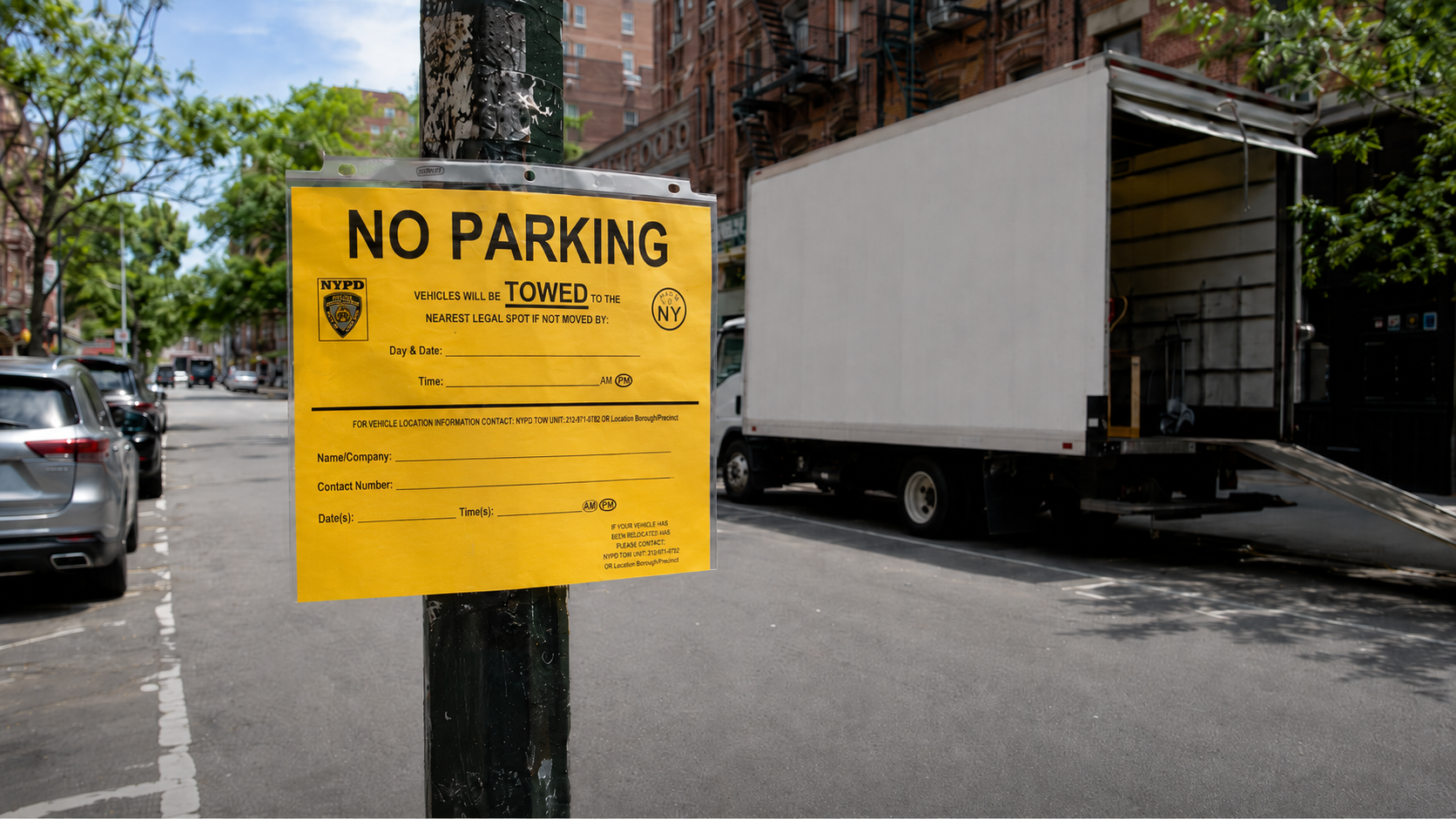
    Yellow NYC temporary No Parking sign on a Manhattan street with a white moving truck in the background

    Quick Answer: Do You Need an NYC Moving Permit?

    In NYC, you don’t need a permit to move — but you may need a Temporary No-Parking Permit to reserve a parking spot for your moving truck. These are issued by NYC DOT. They’re not always required, but strongly recommended for street-level moves where truck parking is uncertain. Cost: $15–$45 per sign per day. Allow 5–10 business days to process.

    What Is an NYC Moving Permit?

    A “moving permit” in NYC is technically a Temporary No-Standing permit issued by the NYC Department of Transportation (DOT). It allows you to post temporary no-parking signs on a block to reserve curb space for a moving truck during a specific date and time window.

    These signs legally prohibit other vehicles from parking in the designated space during your move, giving your truck guaranteed access to the curb.

    ⚠ Important distinction: You don’t need a moving permit to move. You need it to reserve a parking spot on a public street for your moving truck.

    Do You Need One?

    ✓ You probably need one if:
    ✓Building entrance is street-level with no dedicated loading zone
    ✓Street is narrow with limited truck-accessible parking
    ✓Moving during peak hours when parking is highly contested
    ✓Large move requiring the truck to park for several hours
    ✕ You may not need one if:
    ✕Building has a dedicated loading dock or private parking
    ✕Building management has an alternate parking arrangement
    ✕Quiet residential block with ample street space
    ✕Moving company handles their own parking logistics

    When in doubt, get the permit. At $15–45, it costs a fraction of a parking ticket ($95–$180) or tow ($185+).

    How to Get an NYC Moving Permit

    1

    Apply via NYC DOT

    Visit nyc.gov/dot and search “Temporary No Parking Permit,” or apply in person at an NYC DOT borough office. Online applications are available for most permits.

    2

    Have This Information Ready

    📍 Street address where parking is needed
    📅 Date(s) and time window (add buffer on each end)
    🚗 Number of spaces needed (usually 1–2 for a moving truck)
    👤 Your name, address, and contact information
    3

    Allow 5–10 Business Days

    Standard processing takes 5–10 business days. Expedited processing is available in some cases. Apply early — summer weekend moves see high demand and longer timelines.

    4

    Post the Signs (72 Hours Before)

    Once approved, post your signs at the beginning and end of the reserved zone at least 72 hours before the reserved window begins. This is a DOT requirement — signs posted later are not legally effective.

    5

    Enforce If Needed

    If a vehicle is parked in your reserved zone despite the signs, call 311. NYPD can issue a ticket and arrange towing, but response times vary. Build buffer time into your move schedule.

    One Less Thing to Worry About on Move Day

    EazyCrate delivers reusable plastic moving bins to your door and picks them up after. You handle the permit — we handle the bins.

    Reserve Your Moving Bins →

    Permit Costs by Borough

    Borough Cost Per Sign Per Day
    Manhattan $45
    Brooklyn $15–$25
    Queens $15–$25
    Bronx $15–$25
    Staten Island $15–$25

    A typical single-day move with 2 signs: $30–90 in outer boroughs, $90+ in Manhattan. Still far less than a tow or parking ticket. Also check our NYC moving cost guide for full budget planning.

    Person sitting at laptop filling out an NYC DOT moving permit application with moving boxes visible in the background

    Building Requirements (Separate from the Street Permit)

    On top of street permits, many NYC buildings have their own moving requirements. Confirm all of these with your building management at least 2 weeks before moving.

    📋

    Certificate of Insurance (COI)

    Many buildings require your moving company to provide a COI naming the building as an additional insured. Confirm your mover can provide one before booking. Most reputable NYC movers do this at no extra charge.

    🛗

    Freight Elevator Reservation

    Most large buildings have a single freight elevator reserved for moves. Building management assigns 2–4 hour windows. Missing your freight elevator window is one of the most common causes of move-day delays — confirm early.

    💰

    Move-In / Move-Out Fees

    Some buildings charge a refundable deposit ($200–$1,000) or flat move-in fee. Others restrict moving hours to weekdays 9am–5pm. Ask your new landlord directly — these policies vary widely by building.

    Moving Permit Timeline Checklist

    6+ weeks before
    ✓ Confirm building freight elevator reservation policy
    ✓ Ask building management about COI requirements
    ✓ Confirm your mover can provide a COI
    4 weeks before
    ✓ Apply for NYC DOT No-Parking Permit if needed
    ✓ Reserve freight elevator date + time window with building
    1–2 weeks before
    ✓ Receive permit and plan sign posting locations
    ✓ Confirm mover has COI approval from building
    72 hours before
    ✓ Post no-parking signs at reserved street location
    Move day
    ✓ Confirm truck is parked within permitted zone
    ✓ Have permit document accessible if questioned

    Frequently Asked Questions

    Is a moving permit required in NYC? +
    No — a moving permit is not legally required to move. It’s a temporary no-parking permit for your moving truck’s parking space on a public street. You need it when street parking is uncertain and you need guaranteed truck access.
    How long does it take to get a moving permit in NYC? +
    Allow 5–10 business days for standard processing. For summer weekend moves, apply 3–4 weeks in advance — demand is high and timelines can stretch.
    What is a COI for moving in NYC? +
    A Certificate of Insurance (COI) is a document your moving company provides to prove they carry liability insurance, naming your building as an additional insured. Many NYC buildings require it before allowing a move. Your mover should provide this at no extra charge — always confirm before booking.
    Can my moving company handle the permit for me? +
    Some full-service NYC movers include permit applications in their service. Ask specifically when getting quotes. Many experienced NYC movers are familiar with the process and can apply on your behalf.
    What if a car is parked in my no-parking zone on move day? +
    Call 311 and report the vehicle as illegally parked in your permitted zone. NYPD will respond, but response times vary — sometimes quickly, sometimes not. Always build buffer time into your move schedule rather than counting on immediate enforcement.
    What happens if I move without a permit and my truck gets a ticket? +
    Parking tickets run $95–$180 depending on violation type. If the truck is towed, add $185+ in tow fees plus daily storage. Either scenario costs far more than the permit itself — and a tow can stop your move entirely.

    Permit Handled. Now Handle the Bins.

    EazyCrate delivers reusable plastic moving bins to your NYC door and picks them up after your move. No cardboard, no waste — just an easier move.

    Book Your Moving Bins →

  • How to Pack Wine Bottles for Moving (Without Breaking Them)

    How to Pack Wine Bottles for Moving (Without Breaking Them)

    Packing Guide

    How to Pack Wine Bottles for Moving Without Breaking a Single One

    Wine bottles are one of the most stressful things to move — heavy, fragile, and completely unforgiving of poor packing. A single collision during loading can break a bottle and ruin everything around it. With the right approach, you can move an entire collection safely without specialized equipment.

    Also useful: Renting plastic moving boxes for your move →

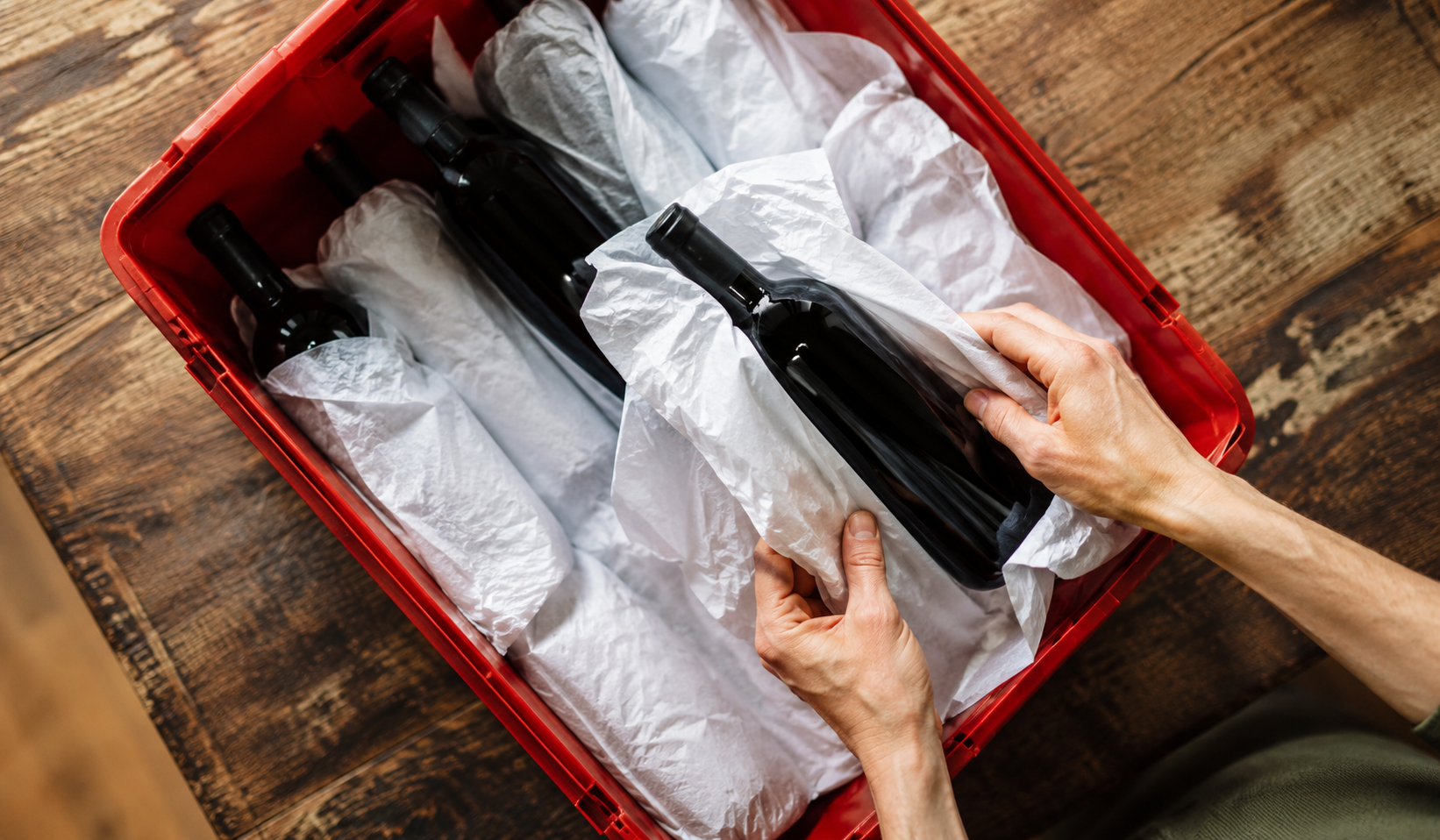
    Wine bottles wrapped in white packing paper inside an orange plastic moving bin — how to pack wine bottles for moving

    Quick Answer: How to Pack Wine Bottles for Moving

    Wrap each bottle individually in packing paper, t-shirts, or bubble wrap, and place upright (or on their side for corked wines) in a sturdy box or wine shipper with dividers. Fill all gaps with crumpled paper so nothing shifts. Label every side FRAGILE + THIS SIDE UP. Keep boxes under 40 lbs (12 bottles max). Never let two unwrapped bottles touch each other — that’s the #1 cause of breakage.

    What You Need Before You Start

    Item Purpose
    Packing paper or newsprint Primary wrap for each bottle (2+ layers minimum)
    Bubble wrap Extra protection for valuable or irreplaceable bottles
    T-shirts or soft towels Zero-waste alternative to packing paper — works just as well
    Double-walled cardboard boxes Structural support; standard boxes aren’t strong enough
    Divider inserts or wine shippers Best option for collections of 6+ bottles
    Crumpled paper or foam peanuts Fill every gap so bottles can’t shift
    Fragile labels or red marker Ensure careful handling throughout the move

    Step-by-Step: How to Pack Wine Bottles for Moving

    1

    Sort by Priority

    Separate bottles into everyday wines (can handle a little roughness), valuable or irreplaceable bottles (need extra protection), and already-opened bottles (transport separately — see below).

    2

    Wrap Each Bottle Individually

    Never put two unwrapped bottles in the same box without a divider. Bottle-on-bottle contact is the #1 cause of breakage. For each bottle: lay packing paper flat, place bottle at a diagonal on one corner, roll toward the opposite corner tucking the ends in as you go. The bottle should be completely covered with at least 2 layers. For valuable bottles: wrap twice — packing paper first, then a layer of bubble wrap.

    3

    Choose Your Box Type

    BestWine Shipper Box — corrugated boxes with individual cardboard dividers. Many wine shops give them away free.
    GoodStandard Box + DIY Dividers — double-walled box with cardboard strips interlocked into a grid. One bottle per cell.
    PremiumSpecialty Wine Moving Box — Styrofoam inserts molded for 6 or 12 bottles. Best for valuable collections.
    4

    Position Bottles Correctly

    Wine TypeCorrect Position
    Corked wineOn its side (keeps cork moist)
    Screw-cap wineUpright — fine either way
    Sparkling / ChampagneAlways upright (carbonation keeps cork moist)
    5

    Fill All Empty Space

    Shake the box gently. If you hear rattling, there’s movement. Fill every gap with crumpled packing paper, foam peanuts, or soft clothing until contents are completely immobile. This step is non-negotiable.

    6

    Seal and Label

    Tape the bottom with 3 strips of packing tape in a cross-pattern. Tape the top the same way. Write FRAGILE and THIS SIDE UP on all four sides and the top with an arrow indicating which way is up.

    7

    Keep Boxes Light

    A box of 12 standard bottles weighs 35–40 lbs. Don’t pack more than 12 bottles per box — heavier boxes are harder to carry safely and far more likely to be dropped.

    Moving Your Whole Household? Make It Easier.

    EazyCrate delivers reusable plastic moving bins to your NYC door. Every room, every item — delivery and pickup included.

    Book Your Moving Bins →

    Can You Pack Wine in Plastic Moving Bins?

    Plastic moving bins (like EazyCrate’s reusable bins) are excellent for most household items, but wine bottles need extra consideration since bins don’t have built-in dividers.

    ✓Wrap bottles individually as described above before placing in the bin
    ✓Lay bottles flat with soft items (towels, sweaters) between each one
    ✓For 6+ bottles: use a dedicated wine box inside the bin
    ✓Bins’ locking lids make them ideal as a bottom-layer truck item — they won’t crush

    For a complete packing strategy, see Should You Rent Moving Bins?

    Neatly organized plastic moving bin with wine bottles wrapped in white packing paper standing upright with dividers

    Handling Special Cases

    🍾 Already-Opened Bottles

    Never pack open bottles with the rest of your wine — they will leak and ruin surrounding bottles. Options: finish them, reseal with a vacuum pump + zip-lock bag and transport in your personal vehicle, or use a portable wine cooler for long-distance moves.

    🍷 Packing Wine Glasses

    Even more fragile than bottles. Stuff the bowl with crumpled paper, wrap the bowl in 2–3 sheets of packing paper, wrap the stem separately with extra layers, and pack glasses upside down (rim down, stem up) with dividers. Never nest glasses rim-to-rim without wrapping between them.

    🏚 Large Collections (50+ Bottles)

    Consider a dedicated wine moving service with climate-controlled transport. Summer truck interiors can exceed 90°F — heat permanently damages wine. Ask your mover directly about wine handling, or ship high-value bottles separately via a wine logistics company.

    Wine Packing Checklist

    ✓All bottles individually wrapped — minimum 2 layers each
    ✓Dividers between every bottle — no bottle-on-bottle contact
    ✓All gaps filled — no shifting when box is moved
    ✓Bottles positioned correctly — corked = on side; sparkling = upright
    ✓Box weight under 40 lbs — 12 bottles maximum per box
    ✓FRAGILE + THIS SIDE UP on all sides and top
    ✓Opened bottles transported separately in personal vehicle

    Frequently Asked Questions

    Can I pack wine bottles in a regular cardboard box? +
    Yes, but use a double-walled box and create dividers so no two bottles touch. Wrap each bottle individually. Without dividers, bottles will contact each other and the impact risk is significant. Wine shipper boxes with built-in dividers are the safer, easier choice.
    Should wine be transported upright or on its side? +
    For corked wines, on their side is ideal for longer storage. For a short move under 24 hours, upright is fine. Sparkling wines and Champagne should always be transported upright. Screw-cap wines are fine either way.
    What if I don’t have wine boxes with dividers? +
    Get wine shipper boxes free from a wine shop, or buy them cheaply online. Alternatively, roll each bottle tightly in a t-shirt or towel and surround with soft items — no two bottles should touch. DIY cardboard dividers in a double-walled box also work well.
    Can wine be damaged in a hot moving truck? +
    Yes — temperatures above 75°F for extended periods permanently damage wine. In summer, moving truck interiors can exceed 90°F. Consider transporting wine in your personal vehicle with AC, or ask specifically about climate-controlled trucks if you have a valuable collection.
    Can I pack wine in plastic moving bins? +
    Yes, with individual wrapping and soft padding between each bottle. Bins don’t have built-in dividers, so each bottle needs to be wrapped and cushioned on all sides. For larger collections, pack wine in a dedicated wine shipper box placed inside the bin.
    How heavy should a box of wine be for moving? +
    Keep wine boxes under 40 lbs — that’s roughly 12 standard bottles. Heavier boxes are harder to carry safely and significantly more likely to be dropped. When in doubt, pack fewer bottles per box and use more boxes.

    Moving Your Whole Household? EazyCrate Makes It Easier.

    Reusable plastic moving bins for every room — delivered to your NYC door. Pickup included after your move. No cardboard, no waste.

    Book Your Moving Bins →

  • Best Neighborhoods in Queens, NYC (2026 Guide)

    Best Neighborhoods in Queens, NYC (2026 Guide)

    Queens NYC Guide

    Best Neighborhoods in Queens, NYC: A 2026 Guide for People Moving to the Borough

    Queens is the most ethnically diverse urban area in the world and NYC’s most underrated borough for people relocating to the city. Lower rents, more space per dollar, excellent transit to Manhattan, and neighborhoods with real community identity.

    Here’s a practical breakdown of Queens’ best neighborhoods for 2026. Compare with our Manhattan neighborhood guide →

    Aerial view of Queens NYC neighborhood at golden hour with Manhattan skyline in the background

    Quick Answer: Best Neighborhoods in Queens

    The best neighborhoods in Queens depend on your priorities. For transit and nightlife: Astoria and Long Island City. For families and space: Forest Hills and Flushing. For the best value in all of NYC: Jackson Heights and Sunnyside. Queens offers Manhattan-caliber amenities at significantly lower rents — and EazyCrate delivers reusable moving bins to every Queens neighborhood.

    Why People Are Moving to Queens

    💰

    Lower Rents

    Average 1BR is $1,400–$2,800/mo vs. Manhattan’s $3,000–$4,500+

    🚇

    Great Transit

    Multiple subway lines with direct Manhattan access in 15–35 minutes

    🏠

    More Space

    More apartment square footage per dollar than any other inner borough

    🍲

    World-Class Food

    One of the best food scenes on earth, concentrated by neighborhood

    Queens Neighborhoods at a Glance

    Neighborhood Avg 1BR Rent Manhattan Commute Best For
    Astoria $2,200–$3,200 ~25 min Young professionals, food
    Long Island City $2,800–$3,800 ~15 min Midtown commuters
    Jackson Heights $1,500–$2,200 ~30 min Value, food, community
    Sunnyside $1,600–$2,400 ~20 min Families, value
    Forest Hills $2,000–$3,000 ~35 min Families, space
    Flushing $1,400–$2,200 ~40 min Value, community
    Ridgewood $2,000–$3,000 ~35 min Creatives, artists

    Neighborhood by Neighborhood

    Astoria

    Best for: Young professionals & food lovers

    💰 $2,200–$3,200/mo
    🚇 N, W lines — ~25 min to Midtown

    Astoria is the most popular Queens neighborhood for people moving from Manhattan. It has the energy of a city neighborhood without the price. Steinway Street, the waterfront park along the East River, the Greek restaurant corridor on 30th Avenue — and increasingly excellent dining from Korean to Japanese to Italian. Long Island City is just south and far more modern — new glass towers, MoMA PS1, and some of the fastest commutes to Midtown in Queens.

    Who it’s for: Creative professionals, young couples, people who want Manhattan access without Manhattan prices.

    Long Island City (LIC)

    Best for: Midtown commuters

    💰 $2,800–$3,800/mo
    🚇 7, E, M, N, W lines — ~15 min to Grand Central

    LIC is the closest Queens neighborhood to Manhattan and has the skyline views to prove it. Also the most expensive part of Queens. The neighborhood has boomed with new development — modern high-rises with amenities — and feels more like a Manhattan extension than a classic Queens neighborhood.

    Who it’s for: People who want the shortest Midtown commute and new-construction amenities without full Manhattan pricing.

    Jackson Heights

    Best for: Value & food diversity

    💰 $1,500–$2,200/mo
    🚇 7, E, F, M, R lines — ~30 min to Midtown

    Jackson Heights is one of NYC’s most remarkable neighborhoods — one of the most culturally diverse square miles on Earth. Roosevelt Avenue and 74th Street offer authentic South Asian, Latin American, and Korean food at a fraction of Manhattan prices. The co-op apartments in the historic district are spacious and undervalued.

    Who it’s for: People who prioritize value, food diversity, and community over prestige.

    Sunnyside

    Best for: Families & community feel

    💰 $1,600–$2,400/mo
    🚇 7 line express — ~20 min to Times Square

    Sunnyside is one of Queens’ most livable neighborhoods for families and young professionals who want a real neighborhood feel. Tree-lined streets, the historic Sunnyside Gardens cooperative housing, good local restaurants, and a direct 7-train express to Times Square.

    Who it’s for: Families, people early in their NYC journey who want value and community.

    Forest Hills

    Best for: Families & space

    💰 $2,000–$3,000/mo
    🚇 E, F, M, R + LIRR — ~35 min to Midtown

    Forest Hills is Queens’ closest approximation to a suburb within the city. The Forest Hills Gardens historic district has Tudor-style architecture, wide streets, and private parks. Very family-oriented, excellent schools, and accessible to both Midtown and JFK.

    Who it’s for: Families, people moving to NYC from suburbs who want space without fully committing to city density.

    Flushing

    Best for: Value & cultural community

    💰 $1,400–$2,200/mo
    🚇 7 line — ~40 min to Midtown

    Flushing is Queens’ second downtown — dense, commercial, and home to one of the most significant Chinatowns outside mainland China. The food scene is extraordinary. Rents are among the lowest in the city for the transit access level.

    Who it’s for: People who want the best possible value in NYC and strong cultural community.

    Ridgewood

    Best for: Artists & creatives

    💰 $2,000–$3,000/mo
    🚇 L, M lines — ~35 min to Midtown

    Ridgewood sits on the Queens-Brooklyn border and has absorbed significant spillover from Bushwick and Williamsburg. Industrial buildings converted to studios and event spaces, an emerging restaurant and bar scene, and more reasonable rents than the Brooklyn side of the same subway line.

    Who it’s for: Artists, creatives, and people who want Brooklyn-adjacent living at slightly lower prices.

    Moving to Queens? EazyCrate Delivers There.

    Reusable moving bins delivered to any Queens neighborhood. Delivery + pickup included. No cardboard, no waste.

    Book Your Moving Bins →

    Moving to a Queens Apartment: What to Prepare For

    Queens moves have a few specific logistical considerations worth knowing before moving day. See our full NYC moving guide for more detail.

    ⚠Narrow stairwells and small elevators — most Queens apartments are pre-war. Uniform bin sizing handles this better than mixed-size cardboard boxes.
    ⚠Parking permits may be required for moving trucks on your specific block.
    ⚠COI requirements — some co-op buildings require a Certificate of Insurance from your movers before the move date.
    ⚠Alternate-side parking rules affect truck timing — confirm street cleaning schedule in advance.

    Also check our NYC moving cost guide to budget your Queens move accurately.

    Young couple carrying orange EazyCrate plastic moving bins up stairs of a Queens walk-up apartment

    Frequently Asked Questions

    Is Queens cheaper than Brooklyn? +
    Generally yes — though Long Island City and parts of Astoria now overlap with Brooklyn pricing. Jackson Heights, Sunnyside, and Flushing are significantly more affordable than comparable Brooklyn neighborhoods.
    What is the most popular neighborhood in Queens for young professionals? +
    Astoria and Long Island City are the top choices. Astoria for neighborhood character and food; LIC for the fastest Midtown commute and modern buildings with amenities.
    What Queens neighborhood is best for families? +
    Forest Hills, Sunnyside, and Flushing consistently rank highest for families due to space, school options, and strong community feel.
    Does EazyCrate deliver to Queens? +
    Yes. EazyCrate delivers reusable plastic moving bins to all Queens neighborhoods — Astoria, LIC, Jackson Heights, Sunnyside, Forest Hills, Flushing, Ridgewood, and everywhere in between. Book online at eazycrates.com.
    What should I know about moving to a Queens apartment? +
    Confirm freight elevator access and building COI requirements with your landlord before booking movers. Most Queens apartments are pre-war with smaller elevators — uniform plastic bins handle narrow stairwells better than assorted cardboard boxes.
    What are the best places to live in Queens for new NYC residents? +
    For first-time NYC residents, Sunnyside and Jackson Heights offer the best combination of value, transit access, and community. Both neighborhoods are welcoming, have excellent food options, and offer direct subway access to Manhattan.

    Ready to Move to Queens?

    EazyCrate delivers reusable plastic moving bins to your door — anywhere in Queens. Pickup included after your move. No cardboard, no waste.

    Reserve Your Moving Bins →

  • Best Moving Apps 2026: Tools That Actually Help

    Best Moving Apps 2026: Tools That Actually Help

    Moving Tools

    Best Moving Apps 2026: The Tools That Actually Make Your Move Easier

    Your phone can manage a significant chunk of your move — from creating a room-by-room inventory to updating your address at 30+ institutions in one session. The hard part is knowing which apps are worth downloading and which are digital clutter. This guide covers the genuinely useful moving apps by category, what each does well, and where it falls short.

    Also useful: Moving to NYC Guide

    Smartphone showing a moving checklist app with keys and plant on a desk — best moving apps 2026

    Quick Answer: Best Moving Apps in 2026

    The best moving apps in 2026 are: Sortly (home inventory), Updater (change of address + utilities), Moving Day – Planner & Tips (checklist + timeline), and Google Maps / Yelp (finding local movers). These four cover the categories where most moves break down: inventory management, admin tasks, timeline planning, and vendor selection.

    Best Moving Apps by Category

    📷

    Sortly — Inventory & Packing

    Best for tracking what’s packed where

    Sortly lets you create a visual inventory of your belongings organized by room, box, or bin. Add photos and notes to each item and generate QR codes to stick on boxes. When unpacking and you can’t find something, search the app instead of opening 12 boxes.

    💰 Free (up to 100 items) / $8/mo full plan
    ⚠ Doesn’t help with logistics or timeline — pure inventory tool
    ✓ Best for large moves or items going into storage
    📋

    Updater — Change of Address & Utilities

    Best for handling all move admin in one session

    Updater connects with your mover (if supported) and lets you transfer utilities, update subscriptions, forward mail, and update your address with dozens of companies from one dashboard. For NYC apartment moves, this is the most time-saving app available.

    💰 Free — available through many moving companies
    ⚠ Not all utilities are connected — DMV, banking, insurance still manual
    ✓ Best for NYC movers with many subscriptions to update
    🗓

    Moving Day Planner — Timeline & Checklist

    Best for step-by-step moving timelines

    Gives you a week-by-week checklist from 8 weeks before your move through move-in day. Covers tasks most people forget: notifying the post office, scheduling elevator reservations, reserving parking, contacting your building super.

    💰 Free with in-app purchase for premium content
    ⚠ Alternative: Google Sheet or Notion template works equally well
    ✓ Best for first-time movers who want a built-in checklist
    📍

    Google Maps + Yelp — Finding Movers

    Best for vetting local moving companies

    Skip aggregator sites that resell your contact info to multiple companies (expect 20 calls). Use Google Maps and Yelp to find movers directly, read verified reviews, and contact companies without a middleman. Look for reviewers who mention your specific situation — NYC walk-ups, pianos, long distance.

    💰 Free
    ⚠ Avoid any site that requires a form before showing pricing — that’s a lead gen site
    ✓ Check how companies respond to negative reviews

    Great Apps + Better Bins = A Smoother Move

    EazyCrate delivers reusable plastic moving bins to your NYC door. Easier to pack, faster to load, picked up after the move.

    Book Your Moving Bins →

    Two More Things Worth Knowing

    Labels: The Analog System Still Wins

    The most reliable labeling system is still a Sharpie, large adhesive labels, and a numbered list in your Notes app. For each box or bin: write the room and number on top and all four sides. Keep a master list — “Box 14 — Kitchen, everyday dishes, coffee mugs.” Digital label apps add a step. The numbered list is faster.

    Moving Insurance: Document Before You Pack

    Before any valuable item goes into a box, photograph it with your phone. This takes 30–60 seconds per item and creates a timestamped record of condition before the move. Check your renter’s insurance policy — most standard policies cover moving damage. Add a rider if needed for high-value items.

    Woman at desk with laptop and moving bins in background — using moving apps to organize a move

    The One Tool Worth Renting, Not Downloading

    Apps organize information. Reusable plastic moving bins organize your actual stuff. Renting bins through EazyCrate eliminates the need for most packing organization apps — bins are uniform in size, lid locks without tape, and you can label them with a single piece of painter’s tape. When movers pick up bins at the same orientation every time, loading is faster and items arrive in better shape.

    0
    Tape needed — lids snap shut
    1
    Size fits all — no box calculator app needed
    100%
    Pickup included — we collect after your move

    Reserve Your EazyCrate Bins →

    Moving App Comparison

    App Category Price Best For
    Sortly Inventory Free / $8/mo Tracking packed items
    Updater Admin Free Change of address, utilities
    Moving Day Planner Timeline Free 8-week moving checklist
    Google Maps / Yelp Finding movers Free Vetting local moving companies
    Notes (iPhone/Android) Labels Free Simple numbered box system

    Apps That Aren’t Worth Your Time

    ✕Move-matching aggregators that sell your info to multiple companies — you’ll get 20 calls
    ✕“All-in-one moving apps” with poor UI and no clear focus area
    ✕Box calculator apps — just get more bins than you think you need and you’re set

    Got the Apps? Now Get the Bins.

    EazyCrate delivers reusable moving bins to any NYC address. See NYC moving costs to plan the rest of your budget.

    Get a Quote →

    Frequently Asked Questions

    Is there an app to help me plan my move? +
    Yes. Moving Day – Planner & Tips gives you a week-by-week checklist from 8 weeks before your move. Alternatively, any to-do app (Todoist, Notion, Apple Reminders) works well with a free moving checklist template from Google.
    What app helps with changing my address when moving? +
    Updater is the most comprehensive option. It connects with utility companies, subscription services, and dozens of organizations to let you update your address in one session. It’s free and available through many NYC moving companies.
    Is there an app to help me inventory what I’m packing? +
    Sortly is the best option. It lets you photograph items, organize by room or box, generate QR codes for bin labels, and search your inventory after the move. Free plan covers up to 100 items; paid plan is $8/month for full home inventories.
    Do moving apps replace hiring movers? +
    No. Moving apps help you organize and plan. You still need people to move your furniture. Apps are most valuable for reducing time spent on administrative tasks — change of address, utilities, scheduling — not for replacing physical labor.
    What is the best tool for labeling moving boxes? +
    A Sharpie and a numbered system in your Notes app is faster than any digital labeling tool. Write the room and number on all four sides and the top of each box or bin. Keep a master list of what’s in each numbered container.
    What are the best free moving apps in 2026? +
    All four recommended apps in this guide are free to use at a functional level: Sortly (free up to 100 items), Updater (free), Moving Day Planner (free), and Google Maps / Yelp (free). You can manage your entire move without paying for any app.

    Great Apps + Better Bins = A Smoother Move

    EazyCrate delivers reusable plastic moving bins to your NYC door. Easier to pack, faster to load, picked up after the move. No cardboard, no tape, no waste.

    Book Your Moving Bins →

  • Zero Waste Moving Guide: How to Move Without the Trash

    Zero Waste Moving Guide: How to Move Without the Trash

    Eco-Friendly Moving

    Zero Waste Moving Guide: How to Move Without Creating a Mountain of Garbage

    The average American move generates between 50 and 100 cardboard boxes — most of which end up crushed on a sidewalk within 48 hours. For a 2-bedroom apartment, that’s 30–40 pounds of cardboard waste from a single move. It doesn’t have to be that way.

    Woman packing reusable plastic moving bins for a zero waste move

    Quick Answer: What Is Zero Waste Moving?

    Zero waste moving means eliminating single-use packing materials — especially cardboard boxes. The most effective approach: rent reusable plastic moving bins, donate items before moving, use clothing and linens as padding, and choose a mover who recycles or packs efficiently. EazyCrate’s reusable bin rental is one of the easiest zero-waste swaps in a typical NYC move.

    Step 1 — Declutter Before You Pack (Not After)

    The most eco-friendly thing you can do before a move is reduce what you’re moving. Every item you don’t bring is an item that doesn’t need a box.

    The Pre-Move Purge Framework

    Go room by room with three categories:

    ✅

    Keep

    You use it regularly or genuinely love it. It comes with you.

    📦

    Donate

    In good condition. Someone else can use it — Goodwill, Housing Works, or a neighbor.

    🗑

    Toss

    Broken, expired, or past its useful life. Let it go before it wastes a box.

    Rule of thumb: If you haven’t used it in 12 months and it has no sentimental value, it doesn’t move with you.

    Where to Donate in NYC

    ✓Goodwill and Housing Works — drop-off locations across the boroughs
    ✓BringIt NYC — bulk furniture pickup
    ✓Freecycle and Facebook Marketplace — large items that need a new home fast
    ✓Food banks — accept non-expired shelf items

    Step 2 — Skip the Cardboard: Use Reusable Plastic Moving Bins

    Cardboard boxes are the biggest source of moving waste. They’re purchased new (or scrounged from liquor stores), used once, and discarded. For a 2-bedroom move, you might use 60–80 boxes. The alternative: rent reusable plastic moving bins.

    Why Plastic Bins Beat Cardboard for Sustainability

    ✓A single reusable bin replaces 50–80 cardboard box uses over its lifetime
    ✓No tape, no box cutters, no broken-down boxes on the sidewalk
    ✓Uniform sizing means better truck packing and fewer trips
    ✓Locking lids protect items without tape or packing paper

    EazyCrate delivers reusable plastic moving bins to your NYC door. After the move, we pick them up and sanitize them for the next renter. No waste, no mess. Learn more about renting plastic moving boxes →

    Reserve Your EazyCrate Bins →

    80x
    One reusable bin replaces up to 80 cardboard boxes over its lifetime
    0
    Tape, cutters, or sidewalk trash when you use EazyCrate bins

    The Easiest Zero-Waste Upgrade: Rent Reusable Bins

    EazyCrate delivers plastic moving bins to your door and picks them up after. No cardboard, no tape, no waste.

    Book Your EazyCrate Bins →

    Step 3 — Replace Bubble Wrap and Packing Paper

    Conventional packing materials — bubble wrap, styrofoam, packing peanuts — are almost entirely non-recyclable. Here’s what to use instead:

    Conventional Material Zero-Waste Alternative
    Bubble wrap Towels, blankets, scarves, sweaters
    Packing paper T-shirts, dish towels
    Styrofoam Pillows, fabric offcuts
    Packing tape Reusable bin lids that snap shut

    Most fragile items can be packed safely in soft clothing. The exception: extremely fragile items like heirloom china or artwork may still require purpose-made protection.

    Person wrapping fragile items in towels instead of bubble wrap for eco-friendly moving

    Step 4 — Choose Eco-Conscious Movers

    Not all moving companies operate the same way. When getting quotes, ask these four questions:

    1

    Do you use fuel-efficient vehicles?

    Some NYC movers operate electric or hybrid trucks. Ask directly — it matters for a sustainable move.

    2

    Do you consolidate loads?

    Many NYC movers consolidate moves going in the same direction, reducing total trucks on the road. Ask about this especially for long-distance moves.

    3

    Do you have a recycling policy?

    Ask if they recycle packing materials after delivery and how they handle items clients leave behind.

    4

    Do you partner with donation orgs?

    Some NYC movers will arrange donation pickups for items you can’t bring. A question worth asking.

    Step 5 — Handle the Aftermath Sustainably

    ♻

    Flatten and Recycle Any Cardboard

    Break down every box flat and bundle for recycling. NYC Sanitation picks up cardboard separately — leave flat bundles tied with twine at the curb.

    📤

    Donate Leftover Packing Materials

    Packing paper, clean bubble wrap, and sturdy boxes can be posted on Nextdoor or in your building’s Facebook group for neighbors who are also moving.

    📦

    Return Rental Bins

    If you used EazyCrate — nothing to do. We pick up the bins at your new address. They’re sanitized and reused for the next move. Zero effort, zero waste.

    Zero-Waste Moving Checklist

    A timeline to keep your move on track and waste-free:

    4+ Weeks Before
    ✓Complete the pre-move purge — donate before packing
    ✓Reserve reusable bins (EazyCrate delivers as soon as 1 week out)
    2 Weeks Before
    ✓Gather soft items — towels, blankets — to use as padding
    ✓Choose a mover with eco-friendly practices
    ✓List large items on Freecycle or Marketplace
    Move Week
    ✓Pack bins using clothing for fragile item padding
    ✓Bring reusable bags for last-minute loose items
    ✓Drop non-moving items at donation center
    After the Move
    ✓Schedule EazyCrate bin pickup
    ✓Flatten and recycle any cardboard used
    ✓Post remaining packing materials to neighbors

    Ready to Move Without the Waste?

    EazyCrate delivers reusable moving bins anywhere in NYC. Pickup included. No cardboard, no tape, no trash.

    Reserve Your Bins →

    Is Zero-Waste Moving Realistic?

    Completely zero waste is hard — tape, labels, and a few plastic items are difficult to eliminate entirely. But reducing waste by 80–90% is realistic for most moves with the steps above.

    The biggest impact comes from two changes: replacing cardboard boxes with reusable bins, and decluttering before you pack. Everything else is secondary.

    Highest Impact

    Swap cardboard for reusable bins

    Eliminates the #1 source of moving waste in a single decision. One EazyCrate order replaces 60–80 boxes.

    Highest Impact

    Declutter before packing

    Fewer items = fewer boxes needed = less waste generated at every step of the move.

    High Impact

    Use textiles instead of bubble wrap

    Towels and sweaters protect items just as well — and you were packing them anyway.

    Good Impact

    Choose eco-conscious movers

    Load consolidation and efficient routing reduce fuel consumption and emissions on move day.

    Frequently Asked Questions

    Are reusable moving bins actually more eco-friendly than cardboard? +
    Yes. A reusable plastic bin replaces 50–80 cardboard box uses over its lifetime and eliminates tape and packing paper entirely. The energy cost of producing and recycling cardboard over those uses far exceeds the production cost of one durable reusable bin.
    Can I wrap all my fragile items in clothing? +
    For most items, yes. Towels, sweaters, and scarves provide excellent cushioning. For extremely fragile or valuable items — heirloom dishes, large mirrors, original artwork — dedicated protection may still be warranted.
    What do I do with leftover packing materials after the move? +
    Post them on Nextdoor or in your building group. Reuse stores (like Materials for the Arts in NYC) sometimes accept clean packing materials. Cardboard goes flat to the curb for sanitation recycling. If you used EazyCrate bins, just schedule a pickup — nothing else to do.
    How do I find eco-friendly movers in NYC? +
    Ask each mover directly about vehicle efficiency, load consolidation, and recycling practices. Some NYC movers advertise green credentials; others simply have more efficient operations. Getting 3 quotes gives you options to compare.
    Does EazyCrate serve all NYC boroughs? +
    Yes. EazyCrate delivers to all five boroughs and parts of New Jersey. Check eazycrates.com for current coverage details.
    What’s the biggest source of waste in a typical move? +
    Cardboard boxes. A 2-bedroom move typically uses 60–80 boxes, generating 30–40 pounds of cardboard waste. Switching to reusable bins is the single highest-impact change you can make for a more sustainable move.

    The Easiest Zero-Waste Move Upgrade

    EazyCrate delivers plastic moving bins to your NYC door and picks them up after. No cardboard, no waste, no mess. See also: Moving to NYC Guide

    Book Your EazyCrate Bins →